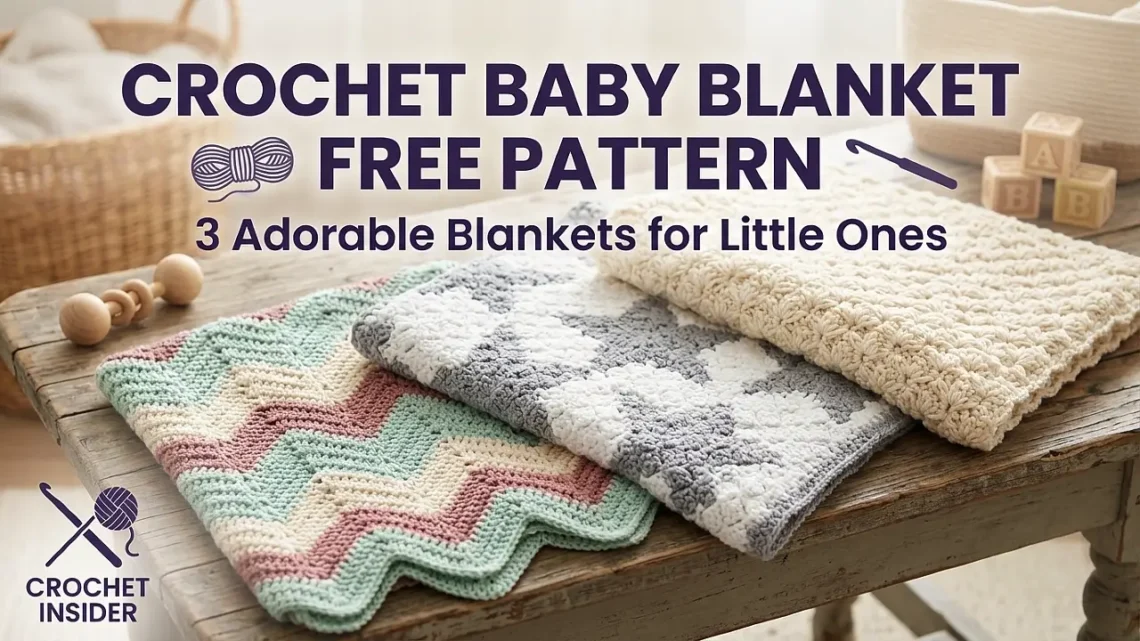
There’s something about a handmade baby blanket that no store‑bought gift can match. I’ve made them for every baby born into my family – plus a few for friends, coworkers, and even a neighbor’s daughter. Each time, the reaction is the same: tears, hugs, and “you MADE this?” That feeling never gets old. In this post, I’m sharing three baby blanket patterns that I’ve personally made many times. They’re all beginner‑friendly, use soft, washable yarns, and work up faster than you think. One uses simple stripes, one has a gentle chevron wave, and one has a beautiful shell texture. Pick your favorite – or make all three.
Choosing the best yarn for baby blankets
Not all yarns belong near a baby. Here’s what I look for – and what I avoid.
My top pick: Bernat Softee Baby
It’s soft, comes in lovely pastels, and survives the washing machine like a champ. I’ve used it for at least a dozen blankets, and they all still look great years later. Worsted weight #3 (light/DK) or #4 – both work beautifully.
Whatever you choose, make sure it’s machine washable and dryable. New parents do not have time for hand‑washing. Also, avoid anything with loose fibers or “eyelash” textures – those can shed and end up in a baby’s mouth.
Pattern 1: Easy striped baby blanket (dc stripes)
This is the blanket I recommend for absolute beginners. It’s all double crochet, worked in rows. You change colors every few rows to create stripes. No counting after the first row – just repeat.
Striped Baby Blanket (approx 30″ x 36″)
Absolute beginnerI’ve made this exact blanket in pastel pink/white/grey for a baby girl, and blue/teal/white for a baby boy. It’s my shower gift default.
Pattern 2: Gentle chevron baby blanket (ripple stitch)
Chevron (or ripple) blankets look impressive, but the stitch pattern is just double crochets with simple increases and decreases. Once you get the rhythm, it’s very meditative.
Chevron Baby Blanket (approx 30″ x 34″)
Beginner+ (increase/decrease)This blanket looks beautiful in ombre (light to dark) or in alternating rainbow stripes. I made one in mint green and white that still gets compliments years later.
→ How to dc2tog (decrease) with step‑by‑step photosPattern 3: Shell stitch baby blanket (textured & lacy)
Shell stitch creates a scalloped, feminine texture. It’s easier than it looks – just groups of 5 double crochets worked into the same stitch, with single crochets in between.
Shell Stitch Baby Blanket (approx 32″ x 36″)
Beginner+ (shell pattern)This blanket is especially pretty in a solid color – the texture shines. I’ve made it in pale lavender and soft cream, and both were gorgeous. It’s also great for using up scraps if you change colors every 2 rows.
Baby blanket size chart (lovey to crib)
Different sizes suit different needs. Here’s a quick guide:
| Type | Size (inches) | Typical use | Starting chain (worsted, ~4 sts/inch) |
|---|---|---|---|
| Lovey / security blanket | 12″ x 12″ to 14″ x 14″ | Small square, often with a stuffed animal head | Ch 30‑35 |
| Cradle / receiving blanket | 18″ x 24″ to 24″ x 30″ | Newborn swaddling, car seat cover | Ch 45‑55 |
| Standard baby blanket | 30″ x 34″ to 36″ x 36″ | Tummy time, stroller, light cover | Ch 80‑95 |
| Crib blanket | 36″ x 45″ to 45″ x 60″ | Fits a standard crib mattress | Ch 100‑130 |
| Toddler / preschool blanket | 40″ x 50″ to 48″ x 60″ | For naptime at daycare, big kid bed | Ch 120‑160 |
For all patterns above, you can adjust the size simply by changing your starting chain (add or subtract multiples of the pattern’s repeat number). Keep in mind that larger blankets need more yarn – a crib blanket might take 800‑1000 yards.
Adding a safe border (no loose loops)
Borders make baby blankets look finished and professional. But safety note: avoid large chain loops or picots – little fingers can get caught. Stick to simple, tight borders.
My go‑to safe border (single crochet + crab stitch)
Round 1: Work single crochet evenly around the entire blanket, with 3 sc in each corner. Round 2: Work crab stitch (reverse single crochet) – this creates a twisted rope edge that has no loops. It’s a bit tricky at first, but it’s the safest option.
If you don’t want to learn crab stitch, just do two rounds of single crochet. That’s perfectly safe and looks lovely.
For a full tutorial on crab stitch, see our crab stitch border guide.
How to wash and care for baby blankets
Let’s be real: baby blankets get messy. Spit‑up, drool, mysterious stains. Here’s how to make sure your handmade gift survives:
- Before gifting, wash your blanket once. This removes any manufacturing residues and pre‑shrinks the yarn. Use a gentle cycle, cold water, and a mild detergent.
- Include a care tag. Write or print a small tag: “Machine wash cold, gentle cycle. Tumble dry low. Do not bleach.” Sew it to a corner.
- For acrylic yarn: It’s very durable. Parents can wash it with regular laundry, but low heat drying is best to prevent pilling.
- For cotton: It may shrink a bit. Wash on cold and lay flat to dry for the first few washes.
What about fabric softener?
I avoid it. Fabric softener can coat acrylic yarn and make it less absorbent (not great for blankets that might wipe drool). A little white vinegar in the rinse cycle works better – it softens and removes odors naturally.
How to package a baby blanket as a gift
A handmade blanket deserves beautiful presentation. Here’s what I do:
- Fold neatly into a square or rectangle.
- Tie with a satin ribbon or twine – add a small handmade tag with the baby’s name (if known) or “Handmade with love.”
- Include a matching hat or booties if you have time – they use very little yarn.
- Gift in a clear cellophane bag or a simple cardboard box with tissue paper.
- Write a short note explaining that the blanket is machine washable – parents will appreciate that practical info.
I’ve given dozens of baby blankets this way, and they always steal the show at the baby shower.
Which blanket will you make first?
All three patterns are tried and true. If you’re a brand new crocheter, start with the striped blanket – it’s all double crochet, no counting shenanigans. If you want a little challenge, try the chevron. And if you want something lacy and feminine, the shell stitch is your girl.
Whichever you choose, remember: the baby won’t care if your edges are perfectly straight or your color changes are flawless. They’ll just know that something soft and warm is wrapped around them, made by someone who cared enough to spend hours with a hook and yarn. That’s the real magic.