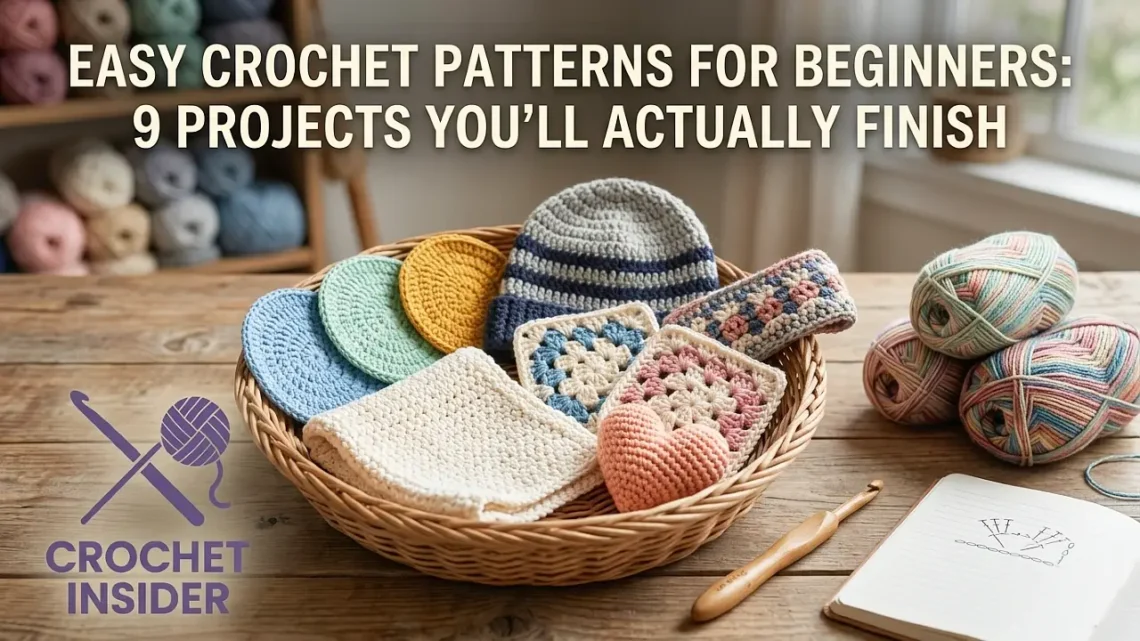
When I first learned to crochet, I wanted to make ALL the things. But every “beginner” pattern I found seemed to assume I already knew how to increase, decrease, crochet in the round, and read cryptic diagrams. Sound familiar? After years of testing and writing patterns, I’ve put together a collection that’s truly for beginners. No secret skills. No weird abbreviations that make you want to throw your hook across the room. Just 9 easy crochet patterns that you can start today and finish this week.
What makes a pattern truly beginner‑friendly?
Not all patterns labeled “beginner” are created equal. I’ve seen patterns that call themselves beginner but require magic rings, invisible decreases, and color changes. That’s not beginner — that’s intermediate in disguise.
A real beginner pattern has these things:
- Only basic stitches: chain, single crochet, double crochet. Maybe half double crochet. That’s it.
- Worked flat (not in the round) or very simple rounds. No complex shaping.
- Rectangle or square shapes. If it’s a hat, it’s a rectangle seamed together. If it’s a bag, it’s two rectangles.
- No gauge required. Or gauge is very loose (e.g., “just make it 6 inches wide”).
- Clear instructions with stitch counts at the end of each row.
All 9 patterns below follow these rules. I’ve made every single one of them myself (some multiple times), and I’ve taught them to absolute beginners who had never held a hook before.
Before you start
If you haven’t yet mastered the chain and single crochet, go through our beginner’s guide or the step‑by‑step tutorial first. But if you can make a chain and work a few rows of single crochet without crying, you’re ready for these patterns.
Quick reference: 9 patterns at a glance
| Pattern | Stitches used | Time to finish | Best yarn |
|---|---|---|---|
| Dishcloth | ch, sc | 1 hour | Cotton worsted |
| Double crochet beanie | ch, dc, slip st | 2‑3 hours | Worsted acrylic |
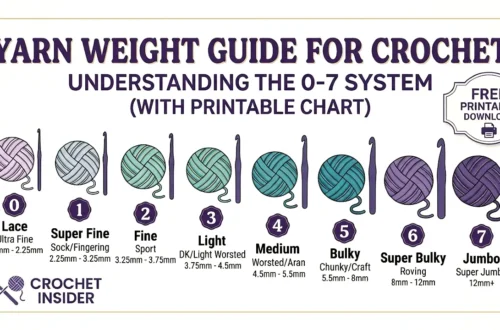
| Chunky scarf | ch, sc | 2 hours | Super bulky #6 |
| Baby blanket | ch, dc | Weekend | Worsted acrylic |
| Washcloth set | ch, hdc | 1 hour each | Cotton |
| Cozy cowl | ch, dc | 2 hours | Bulky #5 |
| Granny square | ch, dc, sl st | 15 min per square | Worsted |
| Fingerless gloves | ch, dc | 2 hours per pair | Worsted |
| Market bag | ch, sc, dc | 4‑5 hours | Cotton worsted |
Pick the one that excites you most. There’s no wrong choice. Let’s dive in.
Pattern 1: Classic beginner dishcloth (single crochet only)
This is the pattern I give to everyone on their first day. It’s impossible to mess up, uses the smallest amount of yarn, and gives you something useful.
Simple Single Crochet Dishcloth
Yarn: Cotton worsted weight #4, 50‑70 yards. Hook: 5.0 mm (H‑8).
Ch 21. Row 1: Sc in 2nd ch from hook and each ch across (20 sc). Ch 1, turn. Rows 2‑20: Sc in each sc across (20 sc), ch 1, turn. After row 20, fasten off and weave in ends.
That’s it. You’ve made a dishcloth. Feel proud.
Full pattern with photos →If you want to get fancy, you can add a border of single crochet around the edges, but it’s truly not necessary. Cotton dishcloths get softer with every wash, and they make fantastic gifts. I keep a stack of these in my kitchen at all times.
Pattern 2: Double crochet beanie (works up in 2 hours)
Hats sound intimidating, but this one is a rectangle that you sew together. No shaping, no decreasing, no working in the round. Just a flat piece folded and seamed.
Rectangle Beanie (Adult size)
Yarn: Worsted weight #4, about 150 yards. Hook: 5.5 mm (I‑9).
Ch 31 loosely. Row 1: Dc in 4th ch from hook and each ch across (28 dc + turning chain = 29 dc? Actually count: ch 31, sk 3 (counts as first dc), dc in remaining 28 chains = 29 dc total). Row 2‑22: Ch 3 (counts as first dc), turn, dc in each dc across. After row 22, fasten off leaving a long tail. Fold the rectangle in half widthwise. Whipstitch the side seam. Gather the top edge with running stitch and pull tight. Weave in ends. Fold up the brim.
Full beanie pattern with sewing tutorial →The first time I made this, I couldn’t believe it actually looked like a hat. It fits most adults, and you can make it in any color. Add a pom‑pom if you’re feeling fancy.
Pattern 3: Easy chunky scarf (super bulky yarn)
Super bulky (#6) yarn is a beginner’s best friend. It works up so fast that you can finish a scarf in one evening. This pattern uses only single crochet.
Chunky One‑Evening Scarf
Yarn: Super bulky #6 (e.g., Lion Brand Wool‑Ease Thick & Quick), 1‑2 skeins (about 100 yards). Hook: 9.0 mm (M/N‑13) or 10.0 mm (N/P‑15).
Ch 12 (for a narrower scarf) or 16 (for wider). Row 1: Sc in 2nd ch from hook and each ch across. Ch 1, turn. Repeat row 1 until scarf is about 60″ long (or desired length). Fasten off, weave in ends. Optional: add fringe by cutting 8″ strands and folding them through the ends.
Full chunky scarf pattern →This scarf is so satisfying. Every row adds visible length, and the thick yarn makes it incredibly warm. I’ve made at least a dozen of these as last‑minute gifts.
Pattern 4: Simple baby blanket
If you’ve already tackled a dishcloth and a scarf, you’re ready for a blanket. But not a giant one — start with a baby blanket. This is the same pattern I shared in our blanket guide, but here’s a condensed version.
Double Crochet Baby Blanket
Yarn: Worsted weight #4 acrylic or cotton, about 600 yards. Hook: 6.0 mm (J‑10).
Ch 85 loosely. Row 1: Dc in 4th ch from hook and each ch across. (You should have 82 dc + turning chain = 83? Honestly, don’t stress the exact number — just count your dc stitches and keep that number consistent.) Row 2‑45: Ch 3 (counts as first dc), turn, dc in each dc across. Continue until blanket measures about 36″. Fasten off, weave ends. Optional: add a single crochet border all around.
Detailed baby blanket pattern →This blanket will take you a weekend or a week of evenings, but the feeling of wrapping a baby in something you made is absolutely worth it.
Pattern 5: Beginner washcloth set (two for one)
Half double crochet (hdc) is the forgotten stitch that’s perfect for washcloths — it’s denser than double crochet but softer than single crochet. Here’s a simple set of two.
Half Double Crochet Washcloth Set
Yarn: Cotton worsted weight, 100 yards total (two colors optional). Hook: 5.0 mm (H‑8).
Ch 24. Row 1: Hdc in 3rd ch from hook and each ch across (22 hdc). Ch 2, turn (the ch 2 does not count as a stitch in hdc). Rows 2‑20: Hdc in each hdc across, ch 2, turn. After row 20, fasten off. Make a second one in a different color. Tie them together with a ribbon for a lovely gift.
Free washcloth pattern →Pattern 6: Cozy cowl (crocheted flat, sewn together)
Cowls are like scarves but better — no dangling ends, and you just pull them over your head. This one is worked flat and seamed.
Beginner’s Cowl
Yarn: Bulky #5 or two strands of worsted held together, about 150 yards. Hook: 8.0 mm (L‑11).
Ch 25. Row 1: Dc in 4th ch from hook and each ch across (22 dc + turning chain = 23? Count your dc). Row 2‑30: Ch 3, turn, dc in each dc across. After row 30, fold the rectangle so the short ends meet. Whipstitch the seam using the yarn tail. That’s your cowl!
Full cowl pattern →I love cowls for beginners because they’re basically a rectangle, but they look so polished. And bulky yarn means it’s done before you lose interest.
Pattern 7: Basic granny square (the real beginner version)
Yes, you can make a granny square as a beginner. The classic granny square uses only double crochet and chains. Let me give you the simplest version.
Simple Solid Granny Square
Yarn: Worsted weight, small amounts. Hook: 5.0 mm.
Round 1: Ch 4, join with sl st to form ring. Ch 3 (counts as dc), 2 dc into ring, ch 2, (3 dc, ch 2) three times. Join with sl st to top of ch 3. Round 2: Sl st into next 2 dc and into ch‑2 space. Ch 3, (2 dc, ch 2, 3 dc) in same space — that’s a corner. Then *ch 1, (3 dc, ch 2, 3 dc) in next ch‑2 space* rep 3 times. Join. To make a larger square, keep adding rounds: in each ch‑2 space you make a corner (3 dc, ch 2, 3 dc), and in each ch‑1 space you put 3 dc.
Full granny square tutorial →Once you master one square, you can make a whole blanket by joining them together. But even just making a few squares as coasters is satisfying.
Pattern 8: Easy fingerless gloves (no shaping)
Fingerless gloves look complicated, but they’re just rectangles with a thumb hole. Seriously.
Rectangle Fingerless Gloves
Yarn: Worsted weight, about 100 yards total. Hook: 5.0 mm.
Ch 20. Row 1: Dc in 4th ch from hook and each ch across. Row 2‑15: Ch 3, turn, dc in each dc across. Fold the rectangle so the short edges meet. Sew the side seam, but leave a 2″ gap about 1″ from the top edge — that’s your thumb hole. Make a second one the same way.
Fingerless gloves pattern →These make incredible gifts for teachers, coworkers, or anyone who types in a cold office. I’ve made dozens.
Pattern 9: Simple market bag (great for summer)
A market bag is a great “next step” after you’ve made a few rectangles. It uses mesh stitches that look fancy but are actually just chains and double crochets.
Beginner Mesh Market Bag
Yarn: Cotton worsted weight, about 200 yards. Hook: 5.0 mm.
Ch 40. Row 1: Dc in 4th ch from hook and each ch across. Row 2: Ch 3, turn, *dc in next st, ch 1, sk 1 st* rep across, ending with dc in last st. Row 3: Ch 3, turn, *dc in next dc, ch 1, sk ch‑1 space* rep across. Repeat row 3 until bag body is about 15″ tall. Then make handles: Ch 3, turn, work 5 dc, ch 20 (skip 20 stitches for handle opening), dc in next 10 sts, ch 20, dc in last 5. Next row: work in pattern across, working 20 dc into each chain space for handles. Continue for 3 more rows, then fasten off. Sew side seams and bottom seam.
Full market bag pattern →This one takes a bit longer, but it’s so satisfying to take to the farmer’s market. And it’s a great way to learn how skipping stitches creates patterns.
How to choose your first pattern
With 9 patterns, you might feel overwhelmed. Here’s how I recommend you choose:
- If you have 1 hour and never crocheted before: Make the dishcloth (#1). It’s the safest bet and you’ll learn the fundamentals.
- If you want something wearable immediately: The chunky scarf (#3) or the beanie (#2). Both work up fast and look impressive.
- If you want a gift for a baby: The baby blanket (#4) — start it on a Friday and you’ll be done by Sunday.
- If you’re already comfortable with basic stitches: Try the market bag (#9) or the granny square (#7) to learn new techniques.
- If you have no idea: Start with the dishcloth. Then the scarf. Then the hat. That’s a perfect beginner progression.
Remember: the goal is not perfection. The goal is finishing something and saying “I made this.” Every single one of these patterns has been tested by real beginners, and every single one is doable. You’ve got this.
What to do after you finish your first pattern
Once you’ve made one of these projects, you’ll be hungry for more. Here’s what I recommend next: