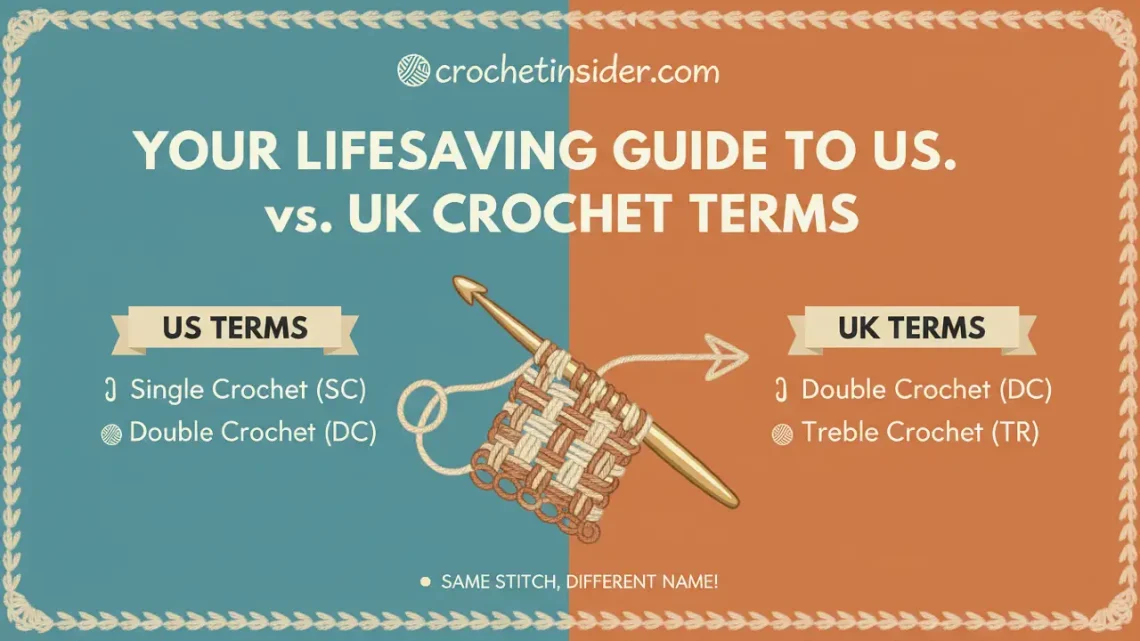
Picture this: You find a stunning pattern for a delicate “double crochet” lace top from a UK designer. You’re excited, grab your hook, and start following the instructions. A few rows in, you realize something is terribly wrong. The fabric is impossibly dense, the top is tiny, and nothing looks like the photo. Why? Because in the UK, “double crochet” (dc) means something completely different than it does in the US. You’ve just fallen into the most common cross-Atlantic crochet trap.
I fell into this trap myself early on, wasting hours and yarn. The truth is, most crochet patterns don’t loudly announce their nationality. It’s up to you, the maker, to be a detective. This guide is your decoder ring. We’ll not only list the terms but explain why the difference exists, teach you how to instantly spot a pattern’s origin, and provide a foolproof method for converting any pattern. Consider this your essential passport for crocheting patterns from anywhere in the world.
The Core Difference: It’s All About the Starting Point
The confusion stems from a different baseline. In both systems, the shortest, simplest stitch has a name.
- US Terminology: The simplest stitch is called the single crochet (sc). All taller stitches are named relative to this: half double, double, treble, etc.
- UK/Australian Terminology: The simplest stitch is called a double crochet (dc). Wait, what? Yes. Their naming is based on the number of loops on the hook or “yarn overs” to start the stitch. A “double” means you pull through two loops at the end. The next tallest stitch is a “treble” (pulling through three loops), and so on. Their “single crochet” doesn’t exist—it’s a slip stitch.
This means the same stitch name produces two different stitches. A US double crochet (a tall, common stitch) is a UK treble. This is why using the wrong terms makes your project the wrong size!
The Ultimate Conversion Chart (Bookmark This!)
| Stitch Description | US TERM | UK/AU TERM | Visual Height |
|---|---|---|---|
| Shortest, flat stitch for joining/moving | Slip Stitch (sl st) | Single Crochet (sc)* | Very Flat |
| The basic, dense workhorse stitch | SINGLE CROCHET (sc) | DOUBLE CROCHET (dc) | Short |
| The versatile, “goldilocks” stitch | HALF DOUBLE CROCHET (hdc) | HALF TREBLE CROCHET (htr) | Medium-Short |
| The tall, fast, common stitch | DOUBLE CROCHET (dc) | TREBLE CROCHET (tr) | Tall |
| Very tall, open lace stitch | TREBLE/TRIPLE CROCHET (tr) | DOUBLE TREBLE (dtr) | Very Tall |
| Extremely tall, for super lacy work | Double Treble (dtr) | Triple Treble (ttr) | Extremely Tall |
*Important: The UK “single crochet” is rarely used in patterns; they usually say “slip stitch.” But technically, that’s the translation.
How to Instantly Detect a Pattern’s Origin (The Clue Hunt)
Don’t rely on the website’s “.com” or “.co.uk”—many designers sell globally. Look for these linguistic clues within the pattern itself:
If you see these terms, it’s almost certainly US Terminology:
- Single Crochet (sc) – The dead giveaway. If this stitch is in the instructions or glossary, it’s US.
- Gauge given in “sc” – Another strong indicator.
- References to “skip” a stitch (UK patterns often say “miss”).
- Yarn weight referred to as “Worsted” or “Aran” (though UK also uses Aran).
If you see these terms, it’s almost certainly UK/Australian Terminology:
- Double Crochet (dc) as the primary short stitch – The biggest clue.
- Treble Crochet (tr) as the standard tall stitch – If “tr” is used where you’d expect a “dc,” it’s UK.
- Half Treble (htr) – The direct counterpart to US hdc.
- References to “tension” instead of “gauge” (though this is less reliable now).
- Yarn weights referred to as “DK” (Double Knitting) or “Aran.”
- Spellings like “colour” or “metres.”
My Rule: If a pattern says “ch 3, dc in 4th ch from hook” and you get a tight little row, it’s US (that’s a foundation sc row). If it says the same and you get a row of tall, open stitches, it’s UK (that’s a foundation tr row).
Beyond Stitches: Other Terminological Quirks
- Yarn Over (yo) vs. Yarn Round Hook (yrh): They mean the same thing. US says “yo,” UK often says “yrh.”
- Skip vs. Miss: US = “skip,” UK = “miss.” (“Sk next st” vs. “miss next st”).
- Color vs. Colour: A hint, but not definitive as many US designers use British spelling for aesthetic reasons.
A Step-by-Step Method for Safely Converting Any Pattern
Let’s say you’ve found a gorgeous UK pattern but you think in US terms. Here’s how to proceed without panic.
- Identify & Confirm: Use the clues above to confirm it’s a UK pattern. Check the designer’s bio or website footer for location.
- Print and Grab a Highlighter: Physical markup helps.
- Convert the Stitch Abbreviations: Go through the pattern and, in the margins, write the US equivalent next to every UK stitch. Use the chart above.
- UK dc = US sc
- UK htr = US hdc
- UK tr = US dc
- UK dtr = US tr
- Leave the Numbers Alone: This is crucial. The stitch counts, chain counts, and row counts do NOT change. You are only changing the name/type of stitch used. A UK pattern that says “Ch 101” still means chain 101. A row that ends with “(50 sts)” still needs 50 stitches.
- Test the Gauge Swatch in YOUR Terms: The gauge will be given in UK stitches. Convert the stitch to US terms and make your swatch accordingly. If it says “10 sts and 12 rows in tr = 4””, you now know to make a swatch in US dc.
- Beware of Special Stitches: Patterns with “front post double crochet (FPdc)” will need to be converted to “front post treble (FPtr)” for a UK pattern, since “dc” becomes “tr.” This is where careful notation is key.
For a full tutorial on this process, see our guide on how to convert crochet patterns between US & UK terms.
Pro Tips for a Bilingual Crochet Brain
- Build a Physical Reference: Print the conversion chart and tape it inside your project notebook or to the wall above your craft space.
- Use Pattern Databases with Filters: Sites like Ravelry allow you to filter patterns by “Terminology” (US or UK). Use this to avoid confusion from the start.
- When in Doubt, Ask or Swatch: In online maker communities, don’t be afraid to ask, “Is this pattern US or UK terms?” Most designers will state it, but if they don’t, the community will know. Alternatively, the first few rows of a pattern will quickly reveal the truth through the fabric it creates.
- Embrace the UK “Treble”: I’ve come to love the UK term “treble” for a double crochet. It feels more descriptive of its height. Learning both systems ultimately makes you a more versatile and resourceful crocheter.
Understanding this terminology divide is a rite of passage. It opens up a whole new world of patterns you might have previously avoided. Now you have the key. Go forth and crochet fearlessly, whether the pattern hails from California, Cardiff, or Canberra.
Expand Your Crochet Vocabulary:
- How to Read Crochet Patterns for Absolute Beginners – Understand the structure first.
- Visual Guide to Basic Stitches (US Terms) – See what each stitch actually looks like.
- How to Read Crochet Charts & Symbols – A universal language!
- Step-by-Step: How to Convert a Whole Pattern Between US & UK – Your practical workshop.