You’re in the yarn store, holding two beautiful skeins. One feels softer, but the other is a better color. The labels are a mosaic of numbers, icons, and tiny text. Which one is right for your project? For years, I chose yarn based on color and “squish factor” alone. I ended up with a “wool” scarf that was mostly acrylic and shed everywhere, and a “cotton” bag that stretched into a saggy mess. The truth is hidden in plain sight: Every yarn label is a treasure map, and the “X” marks the spot for project success.
Learning to read a yarn label is the single most practical skill for a crocheter beyond making stitches. It empowers you to substitute yarns intelligently, care for your finished objects properly, and buy the right amount every time. In this guide, we’ll dissect a standard label line by line, symbol by symbol. I’ll explain not just what each term means, but the practical implications for your crochet. You’ll learn why that mysterious dye lot number is sacred, how to calculate yardage for substitutions, and how to interpret those little washing hieroglyphics. No more guesswork at the craft store—let’s become informed yarn consumers.
The Anatomy of a Yarn Label: A Visual Walkthrough

Part 1: The Essential Facts (The “What Is It?”)
1. Brand & Yarn Name:
Pretty self-explanatory. But note: different “lines” from the same brand can behave very differently (e.g., “Patons Classic Wool” vs. “Patons Decor”).
2. Fiber Content (The Heart of the Matter):
Listed as a percentage. This dictates drape, warmth, washability, and wear.
- 100% Wool: Warm, elastic, can felt if agitated in hot water. Great for winter wearables.
- 100% Cotton: Cool, durable, inelastic, can get heavy. Ideal for summer tops and dishcloths.
- 100% Acrylic: Affordable, consistent, machine-washable, can pill. Good for blankets and practice.
- Blends (e.g., 75% Acrylic, 25% Wool): Aim for the best of both: acrylic’s ease + wool’s warmth. A 50/50 cotton-acrylic blend is softer and more drapey than pure cotton.
- “Superwash” Wool: Wool treated to be machine washable (usually on gentle/cold). A game-changer for baby items and socks.
My Rule: Always feel the yarn, but always trust the label. A “soft” acrylic is still acrylic and won’t block like wool.
3. Yarn Weight & Category Number:
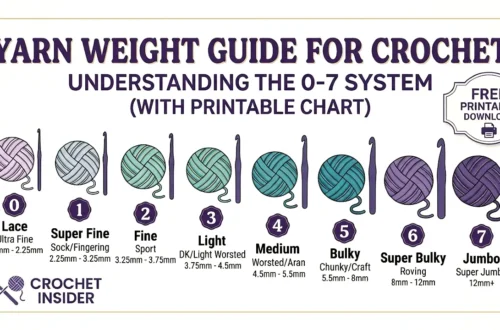
This is NOT the weight of the ball in grams! It’s the thickness of the strand. The Craft Yarn Council’s standardized system uses symbols and numbers (0-Lace to 7-Jumbo). This is the most critical factor for pattern substitution.
- #4 Medium (Worsted/Aran): The most common. If a pattern just says “medium weight,” it’s this.
- #3 DK/Light Worsted: Slightly thinner than worsted. Substituting a DK for a worsted will make a smaller, denser fabric unless you adjust hook size.
- #5 Bulky/Chunky: Thick and fast. Our guide on choosing yarn has a full chart.
Key Insight: The weight symbol is more reliable than the name “Worsted” or “Aran,” which can vary by country.
4. Yardage/Meterage & Weight:
Two numbers: Length (yds/m) and Weight (g/oz). The length is what matters for buying enough yarn.
- Example: “200g / 400yds”
- Why it’s crucial: Two different worsted-weight yarns can have wildly different yardage per 100g ball! Yarn A might give you 220 yds, Yarn B only 180 yds. If your pattern requires 1200 yards, you’d need 6 balls of A but nearly 7 balls of B. Always calculate based on yardage, not weight or number of balls. Use our yarn quantity estimator to help.
Part 2: The Practical Instructions (The “How Do I Use It?”)
5. Recommended Gauge & Hook Size:
This is the manufacturer’s suggestion, not a command. It reads like: “16 sts x 14 rows = 4” in sc with 5.5 mm (I-9) hook.”
- Use it as a starting point for your gauge swatch. But you must match the pattern’s gauge, not the yarn label’s. You may need a different hook size to achieve it.
- It also confirms the weight category. A label suggesting a 2.75 mm hook is clearly a fingering weight, even if the symbol is smudged.
6. Care Symbols (The International Language of Laundry):

These tiny icons are your finished object’s lifeline. Learn them!
- Washtub: Washing. A number = max temperature (°C). Underline = gentle cycle. Hand = hand wash only.
- Triangle: Bleaching. An empty triangle = any bleach. Triangle with lines = only non-chlorine.
- Iron: Ironing. Dots indicate max heat (1 dot = low/cool).
- Circle: Dry cleaning. Letters inside tell the cleaner what solvent to use.
- Square: Drying. A circle inside = tumble dry. Lines = flat dry.
My Advice: Take a photo of the care symbols before you start your project. Attach a note with them to your finished gift. For a full guide, see our post on caring for crocheted items.
Part 3: The Sacred Details (The “Do Not Ignore!”)
7. Dye Lot Number:
This is the most important line for color consistency. Yarn is dyed in large batches called “lots.” Slight variations in color occur between lots.
THE GOLDEN RULE: Always buy enough yarn from the SAME DYE LOT to complete your entire project. Write the dye lot number down when you buy. If you need more later, even if it’s the same color name, a different lot may not match. For large projects like blankets, buy all the yarn at once.
8. Color Name & Number:
“Sea Glass Heather #487.” Useful for reordering, but secondary to the dye lot number.
Part 4: How to Substitute Yarn Like a Pro
Armed with label knowledge, you can confidently swap yarns.
- Match the Weight Category: First and foremost. A #4 for a #4.
- Compare Fiber Content: Switching from wool to cotton will drastically change drape and elasticity. Choose a fiber with similar properties.
- Calculate Yardage: If the pattern calls for 5 skeins of Yarn A at 200 yds each (1000 yds total), and you choose Yarn B with 150 yds per skein, you’ll need 1000 / 150 = 6.67 → 7 skeins of Yarn B.
- SWATCH! Make a large swatch with your substitute yarn and your chosen hook. Wash and block it. Does it have the right drape, stitch definition, and gauge? If not, adjust your hook size or reconsider the substitution.
The yarn label is your contract with the manufacturer and your guide to success. Take two minutes to read it thoroughly before you fall in love with a color. That small habit will save you from heartache, wasted money, and projects that don’t live up to their potential. Knowledge is power—and in this case, it’s also beautiful, wearable, long-lasting crochet.
Master Your Materials:
- The Big Picture: How to Choose the Right Yarn for Any Project – Context for your label reading.
- Special Yarns: A Guide to Bouclé, Metallic, Chenille & More – Understand unique label claims.
- Conscious Crafting: A Guide to Sustainable & Eco-Friendly Yarns – Decode fiber sourcing.
- Smart Storage: How to Organize Yarn with Labels Intact – Keep your information accessible.