When I first started crocheting, I held the yarn like it was a live snake – too tight, then too loose, then wrapped around every finger until I had no circulation. My stitches were all over the place. Tension is the hardest thing to learn because everyone’s hands are different. There’s no one “right” way to hold the yarn, but there are methods that work for most people. In this guide, I’ll teach you three common ways to hold and tension your yarn – the over‑under method, the pinky wrap, and the index finger loop. I’ll also give you exercises to build even tension. No more loose, holey stitches or tight, cramped hands.
What is tension? (And why it matters)
Tension is how tightly or loosely you hold the yarn as you crochet. It’s the single most important factor in whether your stitches look neat and consistent – and whether your finished project is the right size.
- Too tight: Stitches are hard to work into, the fabric is stiff, your hands cramp, and the project may be too small.
- Too loose: Stitches are gappy, the fabric is floppy, and the project may be too big.
- Just right: Stitches slide smoothly, the hook moves easily, and the finished fabric has a beautiful drape.
The goal isn’t “perfect tension” – it’s consistent tension. Your tension can be a little tight or a little loose as long as it’s the same throughout the project.
The golden rule: don’t fight the yarn
Your hand should guide the yarn, not strangle it. If your fingers are white or you can feel the yarn cutting into your skin, you’re holding too tight. Relax. The yarn will not run away.
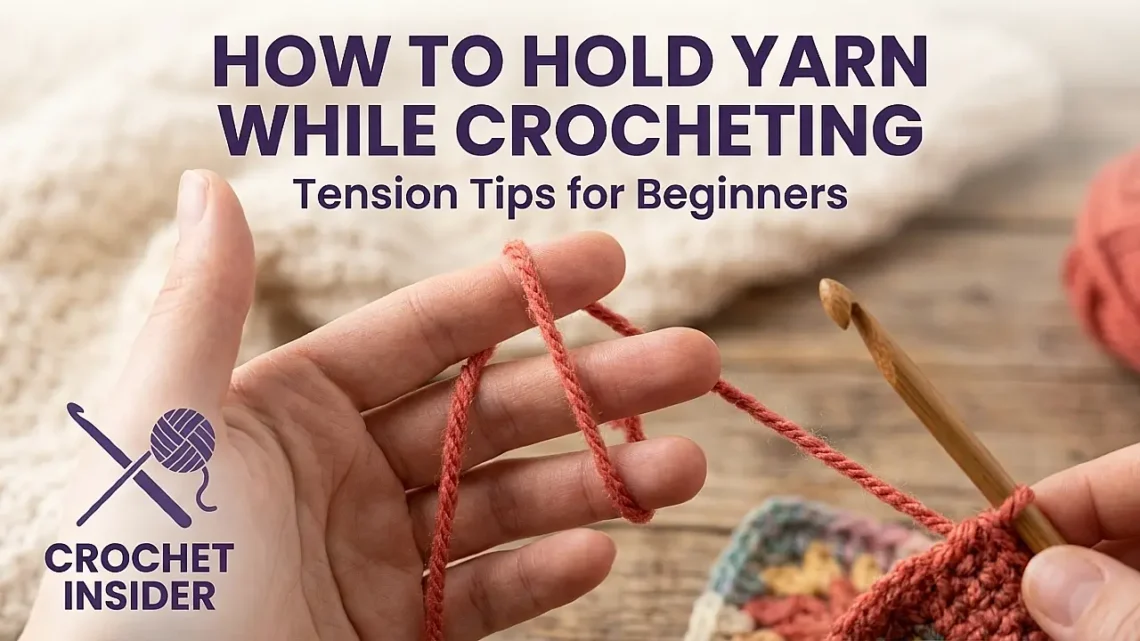
Method 1: The over‑under (pinky to index)
This is the most common method recommended in beginner books. It gives you a good balance of control and flow.
Who this works for: Most beginners find this method intuitive once they practice. It’s great for worsted weight yarn and medium tension.
Potential issues: If you have arthritis or hand pain, the finger threading can be uncomfortable. Try Method 2 instead.
Method 2: The pinky wrap (one loop, steady tension)
This method is simpler – just one loop around the pinky. It’s easier on the fingers and provides very steady tension.
Who this works for: People who find the over‑under method fiddly. It’s also good for bulky yarns where too many wraps create friction.
Potential issues: The single pinky wrap can sometimes be too loose for very fine yarns. If your stitches are gappy, try wrapping twice.
Method 3: The index finger loop (for loose tension or fatigue)
This method is the simplest – just one loop over the index finger. It’s great for people who crochet with very loose tension or who have hand fatigue.
Who this works for: Loose crocheters, people with arthritis, or those who find other methods too constricting.
Potential issues: This method can make it hard to achieve tight stitches if you need them (e.g., for amigurumi). Use a smaller hook to compensate.
Which method should you choose? (Try all three)
Here’s how to decide:
- If you’re brand new: Start with Method 1 (over‑under). It’s the most standard and gives you the most control.
- If your hand cramps: Try Method 2 (pinky wrap) – fewer finger movements.
- If your stitches are always too tight: Try Method 3 (index loop) to force yourself to loosen up.
- If your stitches are always too loose: Try Method 1 or 2 and consciously squeeze your fingers a bit more.
- If none work: Search YouTube for “crochet tension methods” – there are dozens of variations. Some people wrap around two fingers, some use a tension ring. You’ll find what works.
Important: Your grip and tension method may change depending on the yarn weight and project. I use a tighter grip for amigurumi and a looser one for lacy shawls. That’s normal.
Tension practice drills (5 minutes a day)
Like any skill, tension improves with practice. Here are two drills to do each day for a week:
- The long chain: Chain 100 stitches. Don’t look at your hands – just feel the yarn. After 50 chains, your tension will even out naturally. Count how many times you had to stop. Each day, try to stop fewer times.
- The square swatch: Chain 21. Single crochet across (20 sc). Do 10 rows. At the end, measure the width and height. Then do another swatch trying to get the exact same dimensions. Consistent swatches = good tension.
Do these for a few minutes before starting your actual project. They warm up your hands and build muscle memory.
The foolproof tension trick
If you’re struggling, go up or down a hook size instead of trying to force your tension to change. Crocheting tighter is exhausting; using a smaller hook is effortless. Let the hook do the work.
Common tension problems and how to fix them
A word on tension rings
Tension rings are small metal or plastic rings that wrap around your finger with a hook or loop to guide the yarn. They can be helpful if you have arthritis or trouble keeping the yarn on your finger. I’ve tried them – they work for some people, not for others. If you’ve tried all three methods and still struggle, a tension ring (under $10 on Amazon) might be worth a shot.
Your tension will improve with time
Don’t expect perfect tension on your first project. I’ve been crocheting for over a decade, and my tension still changes depending on my mood, the temperature, and the yarn. The goal is not perfection – it’s enjoyment. Pick one method, practice the drills, and be patient with yourself. Your hands will figure it out.