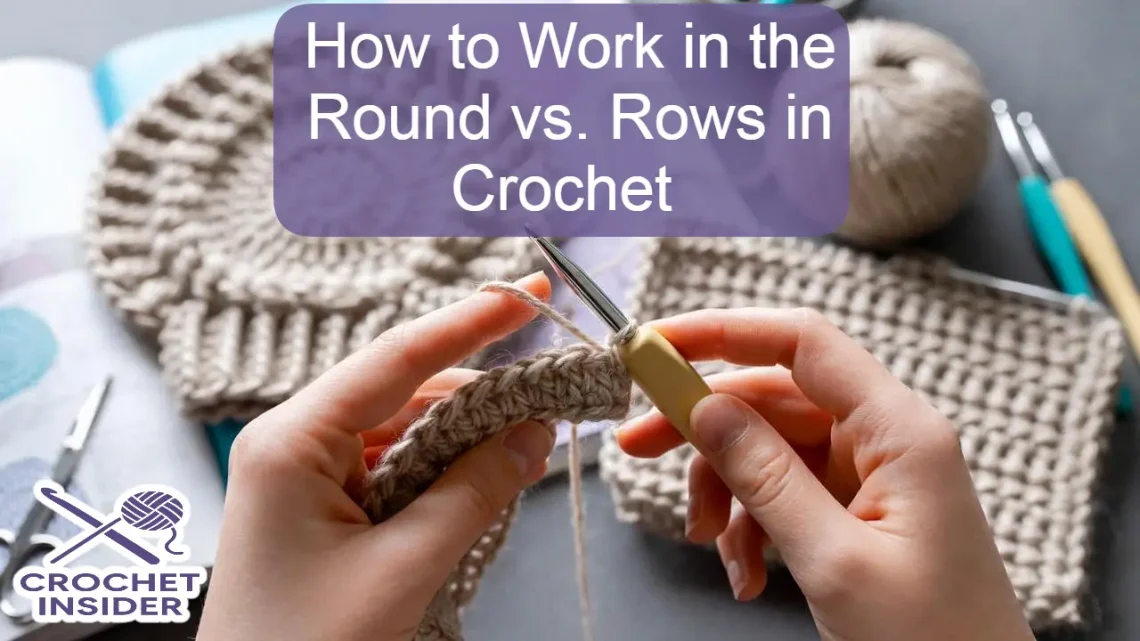
When you first learn to crochet, you typically learn to work back and forth in rows, creating a flat rectangle. It’s logical and straightforward. But then you see a pattern for a beanie, and it says to work “in the round.” Or you want to make a cute amigurumi owl, and the instructions begin with a “magic ring.” Suddenly, you’re asked to think in circles, not lines. This transition can feel like learning to drive a car and then being handed the keys to a helicopter.
I resisted working in the round for ages, convinced it was too complex. But once I understood the logic, a whole new world opened up: seamless hats, perfect spheres, and intricate mandalas. In this guide, I’ll demystify the two fundamental ways to build crochet fabric. We’ll go beyond the “how-to” and explore the *why* and *when* for each method. You’ll learn the distinct advantages, the common pitfalls (like curling or the dreaded “seam”), and how to decisively choose the right technique for your project. By the end, you’ll look at a pattern photo and immediately know how it was constructed, giving you the power to adapt and modify with confidence.
Part 1: Working in Rows – The Foundation of Flat Pieces
Definition: Creating fabric by crocheting a row of stitches, turning your work, and crocheting back in the opposite direction. This builds a flat, two-sided fabric.
Key Characteristics:
- Two Sides: Creates a “Right Side” (the public, neat side) and a “Wrong Side” (the back). Some stitch patterns look different on each side.
- Edges: You have two side edges and a top/bottom edge. These edges often need finishing with a border for a polished look.
- Structure: Excellent for pieces that need to lie flat or be seamed together, like sweater panels, blanket squares, or scarves.
Essential Technique: The Turning Chain
This is the non-negotiable concept for rows. At the end of a row, you make a number of chains (1 for sc, 2 for hdc, 3 for dc, etc.) to bring your hook up to the height of the new row before you turn your work and start back. Whether this chain counts as the first stitch of the new row is a critical piece of information in any pattern. Misunderstanding this is the top cause of accidentally increasing or decreasing. Our guide on reading patterns stresses finding this instruction.
Best For:
- Scarves, blankets, and afghans
- Panels for sweaters, cardigans, and vests
- Bags worked flat and seamed
- Table runners and placemats
- Practicing new stitches in a manageable format
Part 2: Working in the Round – The Secret to Tubes and Circles
Definition: Creating fabric by crocheting in a continuous spiral or in joined rings that progress outward from a center point, forming a tube or a flat circle.
The Two Main Methods:
1. Spiral Rounds (Continuous Rounds):
- How it works: You crochet in one continuous, unbroken spiral. There is no joining at the end of the round and no turning. You simply keep crocheting, placing a stitch marker in the first stitch of each new round to track your start point.
- Pros: Creates a completely seamless, invisible progression. Essential for amigurumi and the tops of hats where a seam would be obvious and distracting.
- Cons: Can be hard to track your rounds (stitch markers are mandatory). The color change point will “travel” slightly up the spiral (a “jog”), which requires a special technique to minimize if doing stripes.
- My Tip: Use a different colored stitch marker to mark Round 1. Move a standard marker up each round. This way, if you get lost, you can always find Round 1 and count up.
2. Joined Rounds:
- How it works: At the end of each round, you join the last stitch to the first stitch with a slip stitch (sl st). You then chain up (e.g., ch 1 for sc, ch 3 for dc) to start the next round, often working the first stitch of the new round into the same stitch as the join.
- Pros: Creates a clear, defined end/start point for each round. Makes color changes clean and aligned. Easier to count rounds. Perfect for granny squares, motifs, and doilies.
- Cons: Creates a visible “seam” line of slip stitches and chains that can be slightly less smooth than a spiral. If your tension on the join is tight, it can pinch the center.
- My Tip: To minimize the seam, try the “invisible join” method when finishing a project, or work the first stitch of the new round in a slightly different location (e.g., into the stitch before the joining sl st) to stagger the seam.
Part 3: Starting in the Round – The Magical Beginnings
You can’t start a circle with a long chain. You need a closed center. Here are the two primary methods:
1. Magic Ring (Magic Circle / Adjustable Ring):
- Wrap the yarn around two fingers to form an “X” on your palm.
- Insert hook under the first strand, grab the working yarn, and pull up a loop.
- Chain 1 (for sc) to secure. Now, crochet your required number of stitches (e.g., 6 sc) over both the ring and the tail.
- Pull the tail end firmly to close the center hole completely. It’s magic! This creates a tightly closed, adjustable center, perfect for amigurumi and hat crowns.
Why I Love It: It eliminates the stubborn hole that often appears in the center of chain-ring starts. It’s a must-learn technique.
2. Chain Ring:
- Chain a small number of stitches (e.g., 4).
- Slip stitch into the first chain to form a ring.
- Work your first round of stitches into the center of this ring, not into the chains themselves.
When to Use It: For patterns where a slightly more open center is acceptable or traditional, like some granny squares or lace motifs.
Part 4: How to Shape in Rounds (The Mathematics of Circles)
To keep a circle flat (like a coaster or doily), you must increase evenly. A flat circle follows a reliable formula:
- For Single Crochet: Start with 6 sc in a magic ring. Round 2: 2 sc in each st (12 sts). Round 3: *Sc in next st, 2 sc in next* repeat (18 sts). You increase by 6 stitches each round.
- For Double Crochet: Start with 12 dc in a magic ring. Increase by 12 stitches each round.
If you don’t increase enough, your circle will cup into a bowl. If you increase too much, it will ruffle. Learning this formula lets you design your own coasters or round rugs from scratch!
To Create a Tube (like a hat body or bag): Once the circle is the desired diameter (e.g., the crown of a hat), you simply stop increasing and work even (same number of stitches each round). This builds the straight sides upward.
Side-by-Side Decision Guide: Which Method Should I Use?
| If you want to make… | Choose… | Key Reason |
|---|---|---|
| A scarf, blanket, or sweater panel | ROWS | Creates flat fabric ideal for seaming or using as-is. |
| A beanie, slouchy hat, or earwarmer | ROUNDS (Spiral or Joined) | Creates a seamless, fitted tube. Spiral for crown, joined can be easier for colorwork. |
| Amigurumi (stuffed animals) | ROUNDS (Spiral) | Seamless spheres and shapes with no weak points for stuffing to escape. |
| Granny squares, motifs, doilies | ROUNDS (Joined) | Defined rounds make crisp motifs that are easy to join later. |
| A bag/pouch | Either! Rounds for a seamless tote. Rows for a flat piece to fold and seam. | Depends on desired look and pattern. |
My final advice? Learn both. Start by mastering a simple hat in the round and a classic blanket in rows. With both techniques in your toolkit, you’ll be able to tackle 99% of the patterns you fall in love with, understanding not just the “how” but the elegant “why” behind every construction choice.
Dive Deeper into Construction:
- Project Guide: Hats, Baskets & Toys in the Round – Put your new skill to work.
- The Art of Shaping: Increases & Decreases for Rounds and Rows – Control your fabric.
- Classic Motifs: The Granny Square (A Joined-Round Masterpiece) – A perfect practice project.
- Advanced: How to Make Seamless (No-Seams) Garments – The ultimate in round construction.