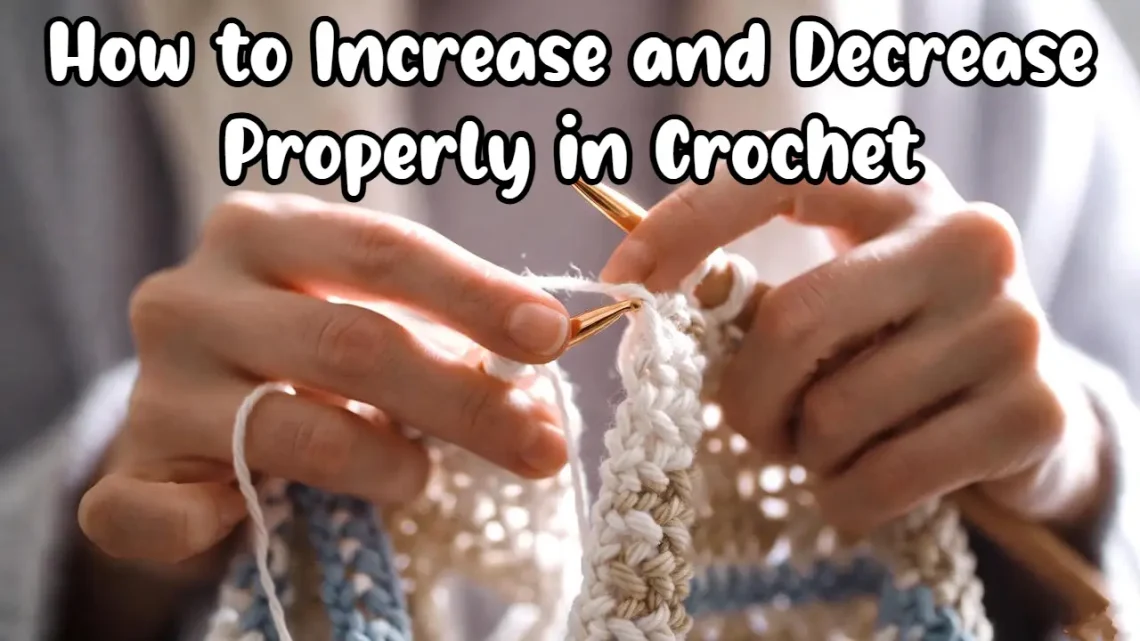
So you can crochet a perfect, straight scarf. Congratulations! But what if you want to make a hat that fits a human head (which is not a cylinder, but an oval), a teddy bear with a rounded snout, or a sweater that contours to your waist? This is where the magic of shaping comes in, and it’s powered by two fundamental actions: increases (making more stitches) and decreases (combining stitches).
My first shaped project was a simple baby hat. I knew I had to increase for the crown, but my increases were lumpy and obvious, creating a hexagon instead of a smooth circle. My decreases for the top were tight and left holes. It looked homemade in the less-than-flattering way. It took me years of trial and error to learn the clean, invisible techniques that professionals use. In this guide, I’ll save you that time. We’ll cover not just the “how,” but the artistry of placing increases and decreases to create fluid curves and angles. You’ll learn the standard methods, the superior “invisible” methods, and the mathematical principles for shaping hats, spheres, and garments. Let’s turn your flat fabric into three-dimensional art.
The Core Principle: Stitch Density Dictates Shape
Think of your crochet fabric as a grid. If you add more stitches in an area (increase), the fabric will expand outward, creating a curve or flare. If you remove stitches from an area (decrease), the fabric will contract inward, creating a curve or angle. The placement and frequency of these changes determine whether you get a gentle slope or a sharp corner.
Part 1: Increases – The Art of Adding Stitches
An increase (“inc”) is simply working more than one stitch into the same stitch from the previous row/round.
Standard Increase (2 st in same st):
This is straightforward. If a pattern says “inc in next stitch” or “2 sc in next st,” you work two complete single crochets (or whatever stitch you’re using) into the designated stitch.
Where to Place Increases for a Flat Circle: This is a classic application. To keep a circle flat, you increase evenly each round.
- For Single Crochet: Start with 6 sc in a magic ring.
- Rnd 2: 2 sc in each st around (12 sts).
- Rnd 3: *Sc in next st, 2 sc in next* around (18 sts).
- Rnd 4: *Sc in next 2 sts, 2 sc in next* around (24 sts).
Pro Tip for Smooth Circles: Stagger your increases. Don’t always stack the increase directly on top of the increase from the previous round. In Round 3, your increases fall on stitches 2, 5, 8, etc. In Round 4, they fall on stitches 3, 7, 11, etc. This creates a more polygonal shape. To get a perfect circle, you’d need to increase in a true spiral, which is more complex. For most projects, staggered increases are perfectly smooth.
Part 2: Decreases – The Subtle Art of Reducing Stitches
This is where technique matters most. A sloppy decrease is bulky and leaves a hole. A clean decrease is nearly invisible.
The Standard Single Crochet Decrease (sc2tog):
- Insert hook into the next stitch, yarn over, pull up a loop. (2 loops on hook).
- Insert hook into the following stitch, yarn over, pull up a loop. (3 loops on hook).
- Yarn over, pull through all three loops on the hook. Two stitches have been combined into one.
The Issue: This method can leave a small gap or a slightly bulky bump because you’re working through the front loops of both stitches in a standard way.
The Invisible Decrease (The Game-Changer for Amigurumi & Fine Work):
This method tricks the eye by working only through the front loops of the two stitches, leaving the back loops free to create the illusion of a full stitch.
- Insert hook under the FRONT LOOP ONLY of the next stitch. Do not yarn over.
- Immediately insert hook under the FRONT LOOP ONLY of the following stitch. You should now have three loops on your hook (the two front loops and the working loop).
- Yarn over and pull through the first two loops on your hook (the two front loops). You now have two loops on the hook.
- Yarn over and pull through the remaining two loops. Complete as a normal sc.
Why it’s better: The untouched back loops sit neatly on the surface, maintaining the “V” appearance of a regular stitch. The decrease is flat and virtually undetectable. I use this for 100% of my amigurumi and hat tops. It’s slightly tighter, which also helps prevent stuffing from showing through.
Important: The “invisible decrease” is specific to single crochet. For taller stitches, the standard decrease is usually fine, but you can adapt the principle by working through specific loops to minimize bulk.
Part 3: Shaping in Action – Common Project Formulas
1. Shaping a Basic Beanie (Top-Down):
- Crown (Circle): Start with 6 sc in a magic ring, increase by 6 each round until the circle is the diameter of the wearer’s head divided by 3.14 (pi). This gives you the crown.
- Sides (Tube): Work even (no increases or decreases) for the desired depth to the ears.
- Decrease for the Top (If closing): To close the hat completely (for a beanie), begin decreasing evenly (e.g., *sc in 8, dec* around, then *sc in 7, dec*, etc.) until only 6-8 stitches remain. Cut yarn, thread through remaining stitches, pull tight, and weave in end.
2. Shaping a Simple Amigurumi Sphere (Ball):
- Increase Phase: Start with 6 sc in magic ring. Increase by 6 each round until you have the desired circumference (e.g., Rnd 1: 6, Rnd 2: 12, Rnd 3: 18, Rnd 4: 24, Rnd 5: 30, Rnd 6: 36).
- Even Phase: Work even for a few rounds to create the height of the sphere (e.g., Rnds 7-10: sc around with 36 sts).
- Decrease Phase: Mirror the increase phase. Decrease by 6 each round (Rnd 11: *sc in 4, dec* around (30), Rnd 12: *sc in 3, dec* (24)…) until small opening remains. Stuff firmly, then continue decreasing until closed.
3. Shaping a Garment (Waist Decrease / Bust Increase):
For a fitted sweater, you’ll place paired decreases along the side “seams” (even if working in the round) to taper at the waist, then paired increases to flare for the bust. The pattern will specify where. The key is to make these changes several stitches in from the edge (e.g., work 3 sts, dec, work to last 5 sts, dec, work 3) to create a smooth slope, not a jagged edge.
Part 4: Troubleshooting Shaping Problems
- My circle is ruffling/wavy: You are increasing too fast. You have too many stitches for the diameter. Try a smaller hook or follow a stricter increase formula.
- My circle is cupping/bowling: You are increasing too slowly. You don’t have enough stitches. Try a larger hook or add more increase rounds.
- My decreases are leaving holes: Your tension is too loose on the decrease, or you’re not using the invisible decrease method for sc. Try tightening up or switching methods. Also, ensure you’re decreasing the correct number of stitches—too few decreases will force the fabric to hole as it pulls inward.
- My shaped edge is jagged, not smooth: You are placing increases/decreases at the same points every row, creating corners. Stagger them! If decreasing for a neckline, use a gradual step-down (e.g., decrease every other row, then every row) rather than all at once.
Shaping is the bridge between beginner and intermediate crochet. It requires planning and precision, but the payoff is enormous: the ability to create anything you can envision, not just what comes in a rectangle. Start by practicing a simple sphere or hat. Once you internalize the rhythm of increasing and decreasing, you’ll have unlocked the third dimension in your craft.
Shape Your Skills Further:
- Amigurumi 101: Basic Shapes & Techniques – The ultimate shaping practice.
- Wearable Guide: How to Measure & Create Accurate Sizing – Apply shaping to garments.
- Project Collection: Hats, Baskets & Toys in the Round – Fun projects to practice on.
- Troubleshooting Guide: How to Fix Shaping Errors – Resc