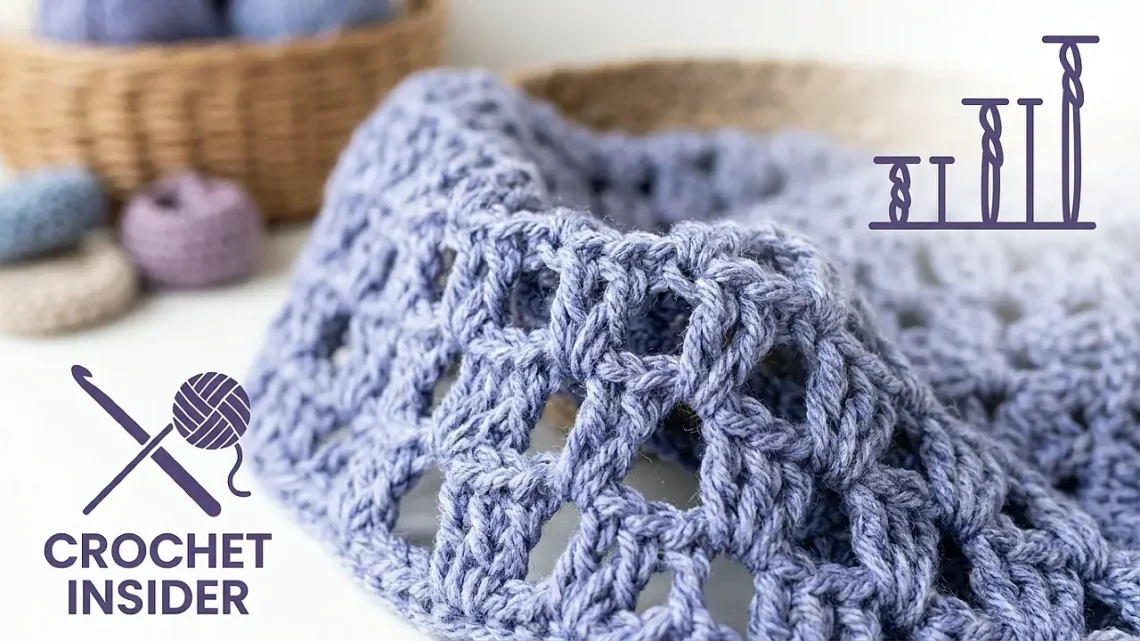
When I first learned treble crochet, I thought, “Who needs a stitch this tall?” Then I made a lacy shawl in treble crochet, and it worked up in a single weekend. Treble crochet (abbreviated “tr”) is the tallest of the basic stitches. It’s about twice as tall as double crochet, which means your projects grow incredibly fast. It’s perfect for open, drapey fabrics like shawls, lightweight blankets, and lacy tops. In this guide, I’ll teach you exactly how to make a treble crochet stitch, how to turn rows (the turning chain is 4 chains, and it DOES count as a stitch), and common mistakes. Plus, 5 projects that use only treble crochet. Let’s go tall.
What is treble crochet? (The tallest basic stitch)
Treble crochet (tr) is a tall stitch. It’s made by yarning over twice before inserting the hook, then pulling through loops in three steps. The result is a loose, lacy fabric that works up very quickly. You’ll use treble crochet for:
- Lacy shawls and wraps – the open fabric drapes beautifully.
- Lightweight summer blankets – warm but not heavy.
- Openwork garments – boho vests, tunics, and cover‑ups.
- Fast projects – because each row is so tall, you cover ground quickly.
Treble crochet is also the basis for double treble, triple treble, and even taller stitches – you just add more yarn overs at the beginning.
Step‑by‑step: how to treble crochet
Let’s walk through the treble crochet stitch slowly. You’ll need a hook and yarn, with a foundation chain ready (see chain stitch guide if needed).
To make another treble crochet, repeat steps 1‑6 in the next stitch. Keep going until the end of the row.
Working treble crochet into a foundation chain
When you work the first row of treble crochet into a chain, you need to skip the first 4 chains. Why? Those 4 chains become the turning chain and count as the first treble crochet of the row.
The rule: If you chain 21, you will treble crochet in the 5th chain from the hook, then each chain after that. The first 4 skipped chains count as the first treble crochet. So you’ll have 16 tr + the turning chain = 17 tr total in the row.
Patterns will say: “Ch 21, tr in 5th ch from hook and each ch across.” That’s your cue.
When you insert your hook into the chain, go under both top loops of the V (the same as single and double crochet).
Turning rows: the turning chain (ch 4) counts as a stitch
Like double crochet, the turning chain for treble crochet counts as a stitch. The turning chain is 4 chains (because a treble is taller than a double).
Remember: ch 4 = first tr
Because the turning chain counts, you will always have the same number of stitches per row (the turning chain + your tr stitches). If you forget to skip the first stitch, you’ll gain an extra stitch each row (rows get wider). If you forget to work into the top of the turning chain at the end, you’ll lose a stitch each row.
Tension tips for tall stitches
Treble crochet can be floppy if your tension is too loose, or stiff if too tight. Here’s how to get it right:
- Don’t pull the yarn tight after each “pull through 2”. Those loops should be relaxed – let the hook determine the size.
- Keep all three “pull through” steps consistent. Don’t yank the yarn tight on the second pull.
- If your treble stitches slant to the left or right, you’re twisting the hook as you pull through. Keep the hook face up.
- If your fabric is too holey, go down a hook size. Treble crochet naturally has gaps, but a smaller hook tightens them.
- If your fabric is too stiff, go up a hook size. You want treble to drape, not stand up.
7 common treble crochet mistakes (and fixes)
Beyond treble: double treble, triple treble (dtr, ttr)
Once you’ve mastered treble, try even taller stitches. The principle is the same: add more yarn overs at the beginning, and add more “pull through 2” steps at the end.
- Double treble (dtr): Yarn over 3 times. Insert, YO, pull up a loop (5 loops on hook). (YO, pull through 2) 4 times.
- Triple treble (ttr): Yarn over 4 times. Insert, YO, pull up a loop (6 loops). (YO, pull through 2) 5 times.
- Quadruple treble (quad tr): Yarn over 5 times… you get the idea.
These are used for very lacy, open fabrics – think doilies, dramatic shawls, and edgings. The turning chain for dtr is ch 5; for ttr, ch 6, etc. And they all count as stitches.
5 projects that shine with treble crochet
Here are beginner‑friendly patterns that use only treble crochet (and chains):
- Treble crochet scarf – Ch 16, tr in 5th ch and each ch across (12 tr + turning chain). Repeat for 60″. Lacy, lightweight, fast.
- Mesh market bag – Worked in the round with (tr, ch 1, sk 1). The tall stitches make the bag stretchy.
- Lacy baby blanket – Ch 85, tr across, repeat for 60 rows. Softer and airier than double crochet.
- Triangle shawl – Increase at the edges and centre every row. Treble crochet creates a dramatic, drapey shawl.
- Summer top – A simple rectangle folded and seamed, worked in tr. Fast and breathable.
For a quick practice project, make a treble crochet dishcloth. It’s not very scrubby, but it dries fast and makes a great gift.
Practice swatch pattern
Here’s a simple swatch to practice your treble crochet. Make it, then unravel and make it again until your tension is even.
Treble Crochet Practice Swatch
PracticeYou’ve mastered the tallest basic stitch
Treble crochet is tall, fast, and dramatic. Now you can make lacy shawls in a weekend, lightweight blankets, and openwork tops. Practice on a scarf – it’s the perfect project for building confidence. Once you’re comfortable, try double treble and triple treble for even more ethereal fabrics. The taller the stitch, the faster your projects grow – and the more impressive they look.