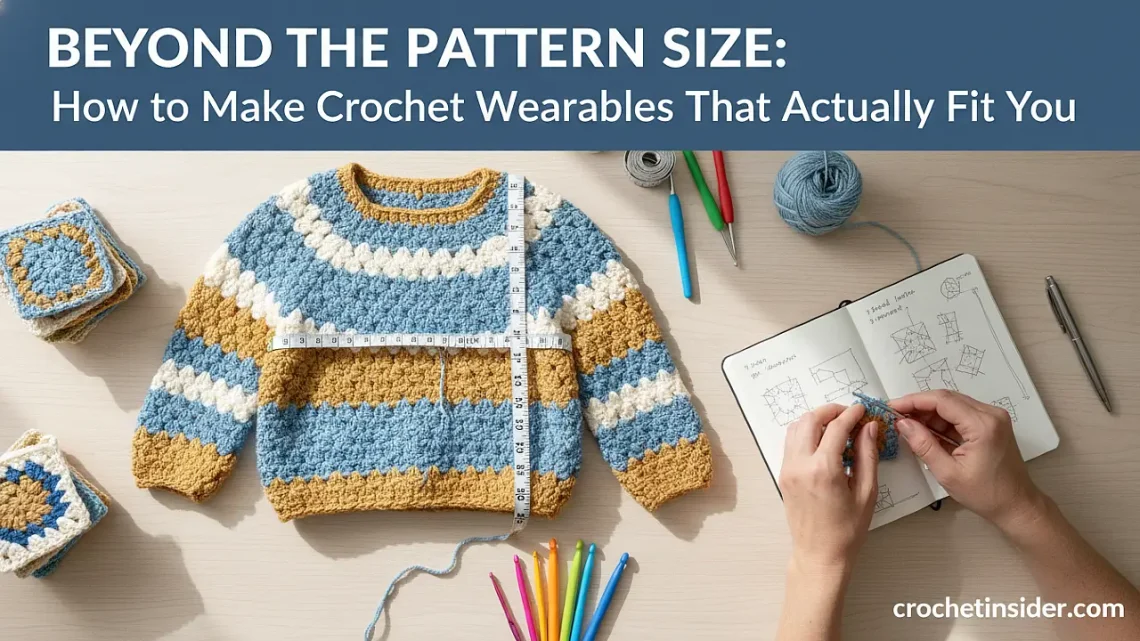
You’ve found the perfect sweater pattern. You’ve swatched religiously, matched gauge, and followed every instruction to the letter. You finish, try it on, and… it’s boxy where it should be snug, tight across the shoulders, or the sleeves are comically long. What went wrong? The pattern’s “Medium” wasn’t your medium. I’ve unraveled more ill-fitting garments than I care to admit before I learned this truth: Pattern sizes are standardized guidelines, not personal guarantees. A flawless fit requires you to become the designer of your own body.
Creating a wearable that fits is the pinnacle of crochet skill. It combines precise technique with personal tailoring. This guide won’t just tell you to “check the schematic.” We’ll dive into the art of taking accurate body measurements, understanding “ease” (the most important concept in garment making), and how to methodically adjust any pattern for your unique shape. I’ll share my fitting checklist, show you how to identify your body type for crochet, and teach you to modify length, width, and sleeve shaping. No more crossing your fingers and hoping for the best—let’s make clothes you’ll love to wear.
Part 1: The Foundation – Taking Accurate Body Measurements
You cannot adjust what you do not know. Grab a soft measuring tape and wear close-fitting clothing (or just underwear). Stand naturally, don’t suck in your stomach. Have a helper if possible.

- Bust/Chest: Measure around the fullest part of your bust/chest, keeping the tape level.
- Waist: Measure around the natural indentation of your waist (usually near the belly button).
- Hips: Measure around the fullest part of your hips and buttocks.
- Cross Back (Shoulder Width): Critical for fit! Measure from the bony protrusion at one shoulder, across your back, to the same point on the other shoulder.
- Armhole Depth: Measure from the bony shoulder point down to where you want the underarm of the garment to sit (usually 1-2 inches below the armpit).
- Sleeve Length: With arm slightly bent, measure from the shoulder point, over the elbow, to the wrist bone (or desired cuff length).
- Garment Length: Measure from the shoulder point down to where you want the hem (hip, waist, thigh).
Write these down in a dedicated notebook. They are your gold standard. Update them every year or so.
Part 2: Decoding Pattern Sizes & Schematics – The “Ease” Factor
Here’s the secret: Your finished garment measurements are NOT your body measurements. The difference is called “ease.”
- Positive Ease: The garment is larger than your body. Creates a loose, relaxed, or oversized fit. Common in comfy cardigans and slouchy sweaters.
- Negative Ease: The garment is smaller than your body. It stretches to fit, creating a close, body-hugging silhouette. Essential for fitted hats, socks, and tight sweaters.
- Zero Ease: The garment matches your body measurements exactly. A tailored fit.
How to Find the Pattern’s Ease: Every good pattern includes a schematic—a drawn diagram with finished measurements for each size. Find the bust measurement on the schematic for your chosen size. Subtract your actual bust measurement. That’s the ease designed into the pattern.
Example: Schematic bust = 42”. Your bust = 38”. Ease = +4” (a relaxed fit).
My Ease Guidelines:
- Fitted Sweater: 0” to +2” ease
- Standard Sweater/Cardigan: +2” to +4” ease
- Oversized/Comfy Cardigan: +4” to +8”+ ease
- Hats: -1” to -2” negative ease (so it stays on!)
- Gloves/Mittens: 0” to +0.5” ease
Choose your pattern size based on the finished garment measurement (including ease) you desire, NOT the generic “Small/Medium/Large” label.
Part 3: The Fitting Roadmap – Where & How to Adjust
You have your body measurements and the pattern’s schematic. Now, compare. Where are the differences? Most adjustments happen in these key areas:
1. Adjusting Width (Bust, Waist, Hips)
This is about adding or removing stitches evenly across a row.
- To Increase Width: Add stitches evenly during the increase sections of the pattern (usually after the ribbing). Calculate how many extra inches you need, multiply by your stitch gauge (sts per inch). Add that many stitches over paired increases (e.g., one at each side “seam”).
- To Decrease Width: Remove stitches evenly during decrease sections. The key is to maintain the stitch pattern repeat. You may need to adjust the starting chain by a few stitches.
- For Bust Darts (Advanced): For a truly fitted female shape, you can add short-row shaping or a few increases just at the bust area, then decrease back for the waist.
2. Adjusting Length (Body & Sleeves)
The easiest adjustment! Simply work more or fewer rows/rounds in the “even” sections of the pattern (the straight parts after shaping and before the next shaping section).
- For a longer torso: Work more rows between the underarm separation and the bottom ribbing.
- For shorter sleeves: Work fewer rounds between the cuff and the sleeve cap shaping.
- Always measure as you go! Lay the piece flat and measure against your body or the schematic.
3. Adjusting Sleeve Cap & Armhole Depth
This is more advanced but crucial for comfort.
- If the armhole is too tight/too high: The pattern’s armhole depth measurement is shorter than yours. You need to make the armhole opening longer (deeper) before splitting for front/back. Do this by working more rows in the body before the armhole shaping begins.
- If the sleeve cap is too tall/too short: Compare the schematic’s sleeve cap height to your measured armhole depth. You may need to adjust the frequency of increases/decreases when shaping the sleeve cap to make it shallower or deeper. This requires careful math and is often easier to find a better-fitting base pattern.
4. Adjusting Shoulders (The Fit Holy Grail)
A garment that pulls across the shoulders is unwearable.
- For Broader Shoulders: Ensure the cross-back measurement of the pattern is at least 1-2 inches wider than your shoulder measurement. If not, you need to add stitches across the back width, which may require modifying both the back and front pieces.
- For Narrower Shoulders: You can sometimes add subtle decreases at the top of the sleeve cap or choose a raglan-style sweater (more forgiving) over a set-in sleeve.
Part 4: My Fitting Checklist & Swatch Strategy
Before you make a single stitch for the garment:
- Swatch in Pattern & Block It: This is non-negotiable. Your gauge swatch must be made in the main stitch pattern, washed, and blocked exactly as you will treat the finished garment. Measure gauge over 4 inches in the center.
- Draw Your Adjusted Schematic: On graph paper, draw the pattern’s schematic for your size. Then, using a colored pen, overlay your desired finished measurements based on your body + chosen ease. This visual map shows you exactly where you need to add or subtract.
- Do the Math on Paper First: Calculate all stitch adjustments before starting. Write them directly on your pattern. “For my size, work 15 more rows here. Increase 4 extra stitches total at underarms.”
- Make a “Wearable Muslin” (Optional but Wise): For a complex or expensive project, make a test version in a cheap, similar-weight yarn. This lets you test fit without commitment.
- Try On As You Go (For Top-Down Construction): Patterns worked from the top down (like many raglans) are fitting heaven. You can try on the yoke before committing to the body length and sleeve length, adjusting in real-time.
Remember, fit is personal and cultural. The “perfect” fit is the one that makes you feel confident and comfortable. Don’t be a slave to the pattern. Use it as a blueprint, and build the house that fits you perfectly. The first time you finish a sweater that feels like it was made just for you (because it was!), you’ll understand why this knowledge is the most powerful in a crocheter’s toolkit.
Become a Master of Fit:
- Step 1: Master Gauge & Tension for Consistent Sizing – The non-negotiable foundation.
- Step 2: Decode Pattern Schematics & Instructions – Understand the blueprint.
- Construction Focus: Seamless Top-Down Garments for Easy Fitting – The best method for adjustments.
- Practice Project: A Fitted Cardigan with Clear Instructions – Apply your skills.