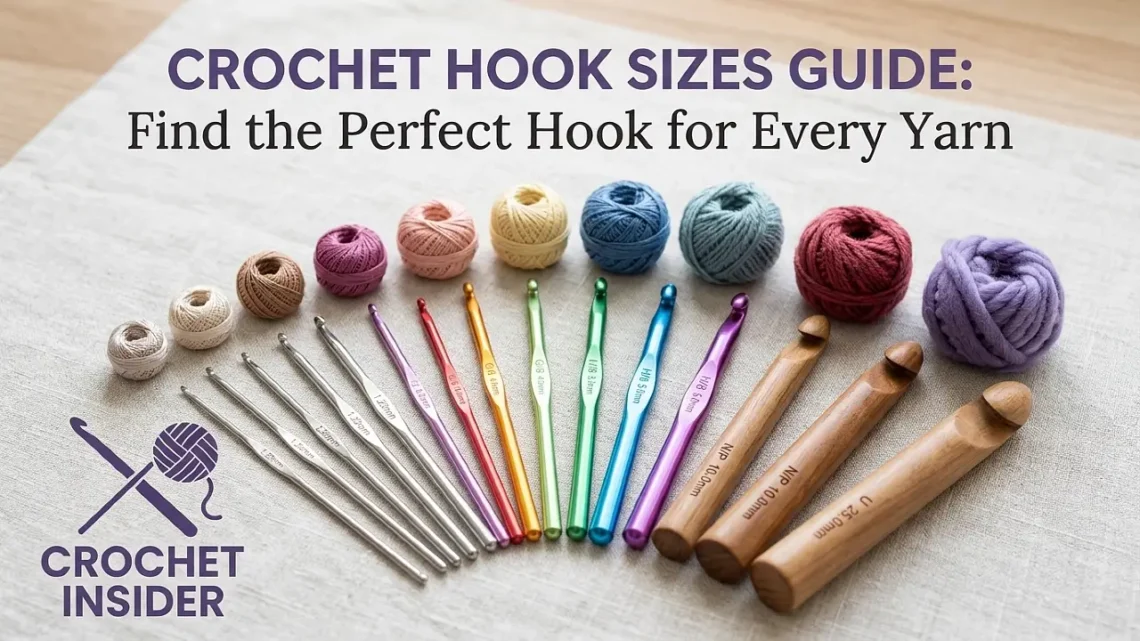
When I first started crocheting, I bought a 5.0mm hook because that’s what the beginner kit came with. Then I bought a pattern that called for a 3.5mm hook, and I had no idea if that was bigger or smaller. Then I saw a vintage pattern that said “No. 7 hook” and I almost gave up. Hook sizing is confusing – metric, US letters, UK numbers, old steel sizes… it’s a mess. But once you understand the system, it’s actually simple. In this guide, I’ll explain every sizing system, give you a complete conversion chart, and tell you exactly which hook to use for any yarn and project. Print the chart. Keep it in your hook case. You’ll use it forever.
Why hook size matters (more than you think)
Hook size determines the size of your stitches. A larger hook makes bigger loops; a smaller hook makes smaller loops. That affects:
- Gauge – stitches per inch. If you use a hook that’s too large, your project will be too big. Too small, it’ll be too small.
- Drape – a larger hook creates a looser, softer fabric. Good for scarves and shawls.
- Stiffness – a smaller hook creates dense, stiff fabric. Good for amigurumi and bags.
- Yarn consumption – larger hooks use more yarn per stitch.
Choosing the right hook is the difference between a blanket that feels like a cloud and one that feels like cardboard.
The three sizing systems: metric, US, UK
You’ll see three different sizing systems on hooks, depending on where they’re made.
1. Metric (millimetres)
This is the standard system worldwide. The hook is labelled with its diameter in mm – 2.5mm, 3.5mm, 5.0mm, etc. This is the most reliable and consistent system. Always check the metric size if you’re unsure.
2. US letter/number system
Used in North America. Smaller hooks have larger numbers (weird, right?). For example, a B‑1 is small (2.25mm), an S is huge (19mm). Common sizes: E‑4 (3.5mm), G‑6 (4.0mm), H‑8 (5.0mm), I‑9 (5.5mm), J‑10 (6.0mm), K‑10.5 (6.5mm).
3. UK/Canadian system (old)
Rarely used now, but you’ll see it in vintage patterns. Uses numbers like “No. 13” (2.25mm) or “No. 4” (6.0mm). The smaller the number, the larger the hook – opposite of US. A conversion chart is essential.
My advice: Ignore the letters and UK numbers. Look at the metric size (mm). That’s the truth.
Complete conversion chart (print this!)
Here’s a comprehensive chart from the smallest steel hooks to the largest jumbo hooks.
| Metric (mm) | US | UK (old) | Typical use |
|---|---|---|---|
| 0.6 mm | — | — | Lace/thread |
| 0.75 mm | — | — | Lace/thread |
| 1.0 mm | — | — | Lace/thread |
| 1.25 mm | — | — | Thread (size 10) |
| 1.5 mm | — | — | Thread (size 5) |
| 1.75 mm | B‑1 (steel) | — | Lace/doilies |
| 2.0 mm | — | 14 | Lace/fingering |
| 2.25 mm | B‑1 | 13 | Fingering/sock yarn |
| 2.5 mm | — | 12 | Fingering/DK |
| 2.75 mm | C‑2 | — | Fingering/DK |
| 3.0 mm | — | 11 | DK yarn |
| 3.25 mm | D‑3 | 10 | DK/light worsted |
| 3.5 mm | E‑4 | 9 | Light worsted (amigurumi) |
| 3.75 mm | F‑5 | — | Worsted (tight tension) |
| 4.0 mm | G‑6 | 8 | Worsted (standard small) |
| 4.5 mm | 7 | 7 | Worsted |
| 5.0 mm | H‑8 | 6 | Most common beginner hook |
| 5.5 mm | I‑9 | 5 | Worsted (looser drape) |
| 6.0 mm | J‑10 | 4 | Bulky yarn, blankets |
| 6.5 mm | K‑10.5 | 3 | Bulky/super bulky |
| 7.0 mm | — | 2 | Super bulky |
| 8.0 mm | L‑11 | — | Super bulky |
| 9.0 mm | M/N‑13 | — | Jumbo |
| 10.0 mm | N/P‑15 | — | Jumbo |
| 12.0 mm | P‑16 | — | Jumbo |
| 15.0 mm | Q | — | Extreme jumbo |
| 19.0 mm | S | — | Arm crochet |
For a printable PDF version of this chart, see our free hook size chart download.
How to match hook to yarn weight
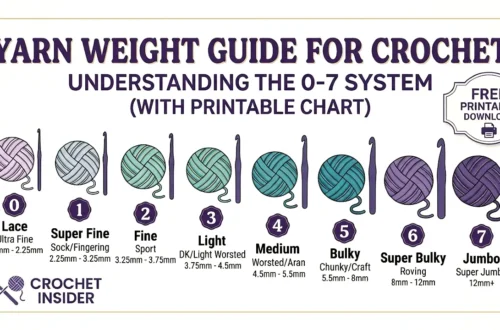
Every yarn label has a recommended hook size. But that’s just a starting point. Here’s my general guide:
| Yarn weight | Recommended hook (mm) | US size | Best for |
|---|---|---|---|
| Lace (0) | 1.5 – 2.25 mm | B‑1 or smaller | Doilies, shawls |
| Super fine / fingering (1) | 2.25 – 3.0 mm | B‑1 to D‑3 | Socks, lightweight garments |
| Fine / sport (2) | 3.0 – 3.5 mm | D‑3 to E‑4 | Baby clothes, hats |
| Light / DK (3) | 3.5 – 4.5 mm | E‑4 to 7 | Garments, accessories |
| Medium / worsted (4) | 4.5 – 5.5 mm | 7 to I‑9 | Beginner projects, blankets, hats |
| Bulky (5) | 5.5 – 6.5 mm | I‑9 to K‑10.5 | Quick blankets, chunky scarves |
| Super bulky (6) | 6.5 – 9.0 mm | K‑10.5 to M/N‑13 | Arm knitting, super quick projects |
| Jumbo (7) | 9.0 – 15.0 mm | M/N‑13 to Q | Rugs, extreme chunky blankets |
My rule of thumb
For a standard worsted weight (#4) yarn, start with a 5.0mm (H‑8) hook. If you crochet tightly, go up to 5.5mm (I‑9). If you crochet loosely, go down to 4.5mm (7). The yarn label might say 5.0mm, but your personal tension is the real guide.
Hook size recommendations by project type
Different projects need different drape and density. Here’s what I use:
- Amigurumi – go down 1‑2 sizes from the yarn label. Tight stitches keep stuffing inside. For worsted yarn, use 3.5mm or 4.0mm.
- Hats & beanies – use the recommended size or one size smaller for a snug fit.
- Blankets – go up 0.5‑1mm from the label for better drape. A 5.0mm hook for worsted becomes a 5.5mm or 6.0mm.
- Scarves & cowls – go up 0.5‑1mm for softness.
- Dishcloths & bags – use the recommended size or one size smaller for density.
- Lace & shawls – use a larger hook than the label to open up the stitches (e.g., 4.0mm for fingering yarn).
For a deep dive into amigurumi hook selection, see our best hooks for amigurumi guide.
Hook materials: aluminum, wood, plastic, ergonomic
Hooks come in different materials, and they feel very different.
My recommendation for beginners: Start with a standard aluminum hook (like a Boye or Susan Bates) in 5.0mm. It’s cheap, durable, and smooth. After a few months, if your hands hurt, invest in an ergonomic hook – you’ll never go back.
Steel hooks for thread crochet (lace weight)
Steel hooks are different. They’re very thin and used for crochet thread (size 10, 20, 30 – the stuff doilies are made of). Steel hooks are numbered with US sizes that get smaller as the number increases (size 7 is larger than size 14). Confusing, right?
Common steel hook sizes: 7 (1.65mm), 8 (1.5mm), 9 (1.4mm), 10 (1.3mm), 11 (1.1mm), 12 (1.0mm), 13 (0.85mm), 14 (0.75mm). Don’t worry about these until you’re making lace.
When to go up or down a hook size
Even with a yarn recommendation, you might need to adjust. Here’s when:
Go up a hook size (larger) if:
- Your stitches are too tight and hard to work into.
- Your gauge has too many stitches per inch (your swatch is too small).
- You want a softer, drapier fabric.
- You’re making a blanket or scarf.
Go down a hook size (smaller) if:
- Your stitches are too loose and sloppy.
- Your gauge has too few stitches per inch (your swatch is too big).
- You want a stiffer, denser fabric.
- You’re making amigurumi, bags, or dishcloths.
If you’re following a pattern and your gauge is off, change your hook size – not your tension. Trying to crochet tighter or looser is exhausting and inconsistent.
How to care for your hooks
Good hooks last a lifetime. Here’s how to keep them nice:
- Aluminum hooks – hand wash with mild soap if they get sticky from yarn residue. Dry immediately. Don’t put in dishwasher.
- Wood hooks – avoid water. Wipe with a soft cloth. Occasionally rub with a tiny bit of beeswax or mineral oil to keep them smooth.
- Ergonomic handles – wipe with a damp cloth. Don’t soak.
- Store in a case – a roll‑up hook case or a pencil case prevents scratches and damage.
I’ve had my favourite Clover hook for 8 years and it still works perfectly. Take care of them, and they’ll take care of you.
Your hook size toolkit
Now you know everything. Bookmark this page, print the conversion chart, and keep it with your crochet supplies. The next time a pattern calls for a “size G‑6” hook, you’ll know that’s 4.0mm. When a vintage pattern says “No. 3 hook,” you’ll know it’s 6.5mm. And when you’re standing in the craft store, confused, you’ll just look at the metric size and grab the right hook.