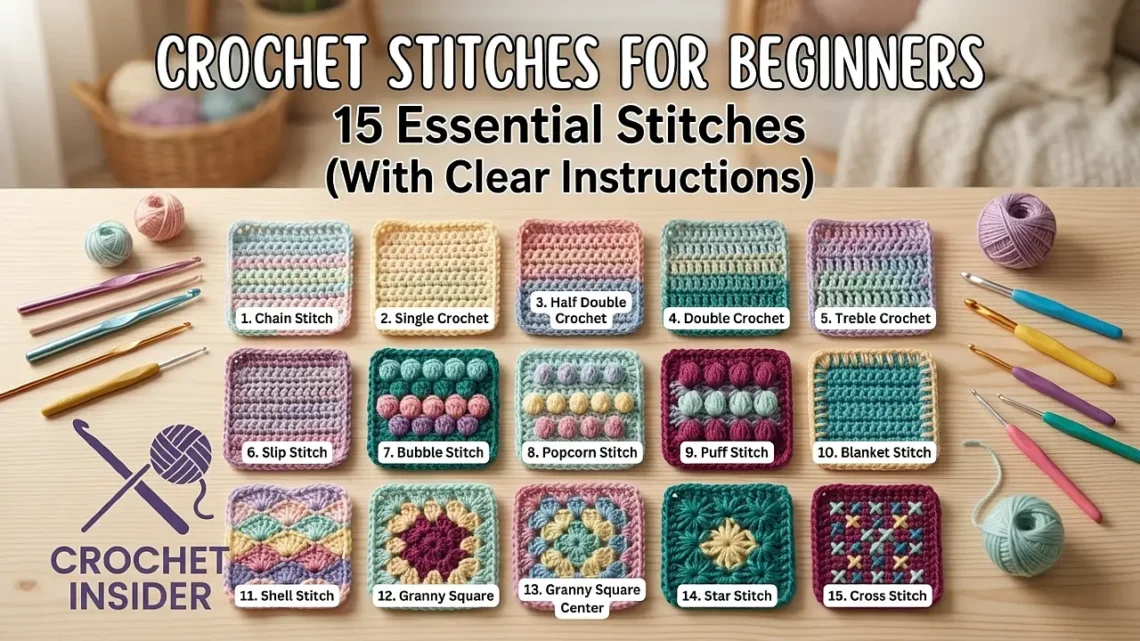
When I first started crocheting, I thought there were maybe five stitches. Then I discovered there are hundreds. HUNDREDS. And I panicked. But here’s the truth that took me way too long to learn: you only need a handful of stitches to make almost everything. Everything else is just a variation or a combination. In this guide, I’ve gathered 15 stitches that every beginner should know — from the absolute basics to a few fancy ones that look complex but aren’t. I’ll tell you exactly how to make each one, what it’s good for, and where you’ve probably seen it before.
How to read stitch instructions (before we start)
Every stitch pattern is written the same way: a sequence of actions like “yarn over,” “insert hook,” “pull through loops.” Once you understand the basic actions, you can learn any stitch. Here are the key terms you’ll see in this guide (and every pattern):
- YO — yarn over: wrap the working yarn over your hook from back to front.
- Insert hook — put the hook into the designated stitch or space.
- Pull up a loop — YO and draw the yarn through the stitch (but not through the loop on your hook).
- Pull through X loops — YO and draw the yarn through the specified number of loops on your hook.
- Sk — skip a stitch.
- Sp — space (like a chain space).
All stitches in this guide use US terminology. If you’re using UK patterns, the names change: US single crochet = UK double crochet, US double crochet = UK treble, etc. We have a conversion chart if you need it.
The 5 foundation stitches (chain, slip, sc, hdc, dc)
These are the building blocks of everything. If you learn these five, you can already make 80% of patterns out there. I’ve covered them in detail in our beginner’s guide and step‑by‑step tutorial, so here’s a quick refresher.
Chain Stitch (ch) Beginner
How to: YO, pull through loop on hook. Repeat.
Best for: Foundation rows, creating spaces, turning chains, and as a decorative element in lace.
Common in: Every single project ever made. Literally everything starts with a chain.
Slip Stitch (sl st) Beginner
How to: Insert hook into stitch, YO, pull through stitch AND the loop on your hook in one motion.
Best for: Joining rounds, moving across your work without adding height, seaming, and surface crochet.
Common in: Granny squares, amigurumi (to close rounds), and edgings.
Single Crochet (sc) Beginner
How to: Insert hook, YO, pull up a loop (2 loops on hook), YO, pull through both loops.
Best for: Dense fabrics, dishcloths, amigurumi, bags, and any project needing structure.
Common in: Almost everything. It’s the shortest of the “real” stitches.
Half Double Crochet (hdc) Beginner
How to: YO, insert hook, YO, pull up a loop (3 loops on hook), YO, pull through all 3 loops.
Best for: Hats, cowls, baby blankets — anything that needs a soft but not too tall stitch.
Common in: The “goldilocks” stitch — not too short, not too tall. Very popular for wearables.
Double Crochet (dc) Beginner
How to: YO, insert hook, YO, pull up a loop (3 loops), (YO, pull through 2 loops) twice.
Best for: Blankets, scarves, garments — anything that should work up quickly and have nice drape.
Common in: Granny squares, blankets, sweaters. The most used stitch in US patterns.
If you need more detail on these five, check out our step‑by‑step guide with photos for every motion.
Taller stitches: treble and double treble
Sometimes you want even more height than double crochet. That’s where treble (tr) and double treble (dtr) come in. They create loose, lacy fabrics that work up incredibly fast.
Treble Crochet (tr) Beginner+
How to: YO twice, insert hook, YO, pull up a loop (4 loops on hook), (YO, pull through 2 loops) three times.
Best for: Lacy shawls, openwork blankets, quick projects.
Common in: Virus shawl, many lace patterns, and as a component in clusters.
Double Treble Crochet (dtr) Intermediate
How to: YO three times, insert hook, YO, pull up a loop (5 loops), (YO, pull through 2 loops) four times.
Best for: Very lacy, open fabrics. Not used as often, but impressive when it appears.
Common in: Vintage doilies, some shawl patterns, and as a design element.
You can keep going: triple treble (yo four times), quadruple treble, etc. But honestly, once you know the pattern (YO extra times = taller stitch), you can figure out any height.
Texture stitches: back loop only, front loop only, post stitches
These aren’t separate stitches — they’re ways of working into existing stitches to create texture, ribbing, or raised patterns.
Back Loop Only (BLO) Beginner
How to: A normal single crochet, but instead of inserting under both loops of the V, you insert under only the back loop (the one farther from you).
Best for: Ribbing, textured bands, and creating a knit‑like look.
Common in: Hat brims, sweater cuffs, and the “yarn over slip stitch” ribbing.
Front Loop Only (FLO) Beginner
How to: Insert under only the front loop (the one closer to you) instead of both loops. Same as BLO but the opposite loop.
Best for: Creating a “fold line,” decorative ridges, or when you need to leave the back loop available for something else.
Common in: Some amigurumi patterns (to attach limbs), and geometric designs.
Front Post / Back Post Stitches (FPdc / BPdc) Intermediate
How to (FPdc): YO, insert your hook from front to back to front around the vertical post of the stitch below (not into the top loops), then complete a double crochet as normal. BPdc is the same but inserted from back to front.
Best for: Cable patterns, basketweave, and “crochet ribbing” that looks like knitting.
Common in: Aran sweaters, textured blankets, and hat brims that need to be stretchy.
For a full tutorial on post stitches, see our guide to crochet cables and basketweave.
Fancy (but easy) stitches: shell, puff, popcorn, V‑stitch
These look complicated but are actually just combinations of basic stitches worked into the same space. They add instant “wow” factor.
Shell Stitch Beginner+
How to: Work 5 double crochets (or sometimes 3 or 7) into the same stitch or space. That’s a shell. Usually you skip a couple of stitches before and after the shell to create the scalloped effect.
Best for: Blanket borders, shawls, baby blankets, and feminine garments.
Common in: The ever‑popular “shell stitch baby blanket.”
Puff Stitch Intermediate
How to: YO, insert hook, pull up a long loop (to about the height of a double crochet). YO, insert hook again, pull up another loop. Repeat 3‑5 times. You’ll have many loops on your hook. Then YO and pull through all loops. Secure with a chain.
Best for: Sunburst granny squares, textured winter wear, and bags.
Common in: “Puff stitch flower” motifs and the popular “puff stitch beanie.”
Popcorn Stitch Intermediate
How to: Work 5 double crochets into the same stitch. Remove your hook from the loop, insert it into the first of those 5 dc, grab the loop, and pull it through. The 5 dc collapse into a “popcorn” bump.
Best for: Textured blankets, amigurumi details, and as a decorative element.
Common in: “Popcorn stitch blanket” and some granny square variations.
V‑Stitch Beginner+
How to: (dc, ch 1, dc) all into the same stitch. That’s a V. The chain creates a “V” shape. Repeat across, usually skipping 1‑2 stitches between Vs.
Best for: Lightweight shawls, summer tops, and airy scarves.
Common in: The “V‑stitch shawl” — a very popular beginner shawl pattern.
Stitch combinations: moss stitch, lemon peel, granny cluster
These aren’t single stitches — they’re repeating patterns made by alternating basic stitches. They create distinct textures and are great for blankets.
Moss Stitch (aka Linen or Granite Stitch) Beginner+
How to: (sc, ch 1, sk 1 st) repeat across. Next row: sc in the chain‑1 spaces, ch 1, skip the sc. The fabric looks like little woven V’s.
Best for: Scarves, blankets, dishcloths, and any project that needs a flat, drapey fabric with no curling.
Common in: Temperature blankets and “mindless” crochet projects.
Lemon Peel Stitch Beginner+
How to: Alternate single crochet and double crochet across each row. Next row, work sc into the dc from the previous row, and dc into the sc. The bumpy texture looks like lemon peel.
Best for: Blankets, pillows, and washcloths (great texture for scrubbing).
Common in: Baby blankets and home decor.
Granny Cluster (from granny squares) Beginner
How to: 3 double crochets worked into the same space. In granny squares, clusters are separated by chain‑1 spaces (sides) or chain‑2 spaces (corners).
Best for: Granny squares, granny stripe blankets, and anything with a “granny” look.
Common in: The entire granny square family — blankets, bags, cardigans.
For a full library of stitch patterns (including the waffle stitch, basketweave, and cable stitches), see our advanced stitch guide.
Quick reference chart (print this!)
Here’s a printable summary of the 15 stitches, their abbreviations, and what they’re good for. Bookmark this page or take a screenshot.
| Stitch name | Abbreviation | Turning chain | Best uses | Level |
|---|---|---|---|---|
| Chain | ch | — | Foundations, spaces | Beginner |
| Slip stitch | sl st | — | Joining, moving | Beginner |
| Single crochet | sc | 1 | Dense fabrics, amigurumi | Beginner |
| Half double crochet | hdc | 2 | Hats, cowls, soft fabric | Beginner |
| Double crochet | dc | 3 | Blankets, garments, granny | Beginner |
| Treble crochet | tr | 4 | Lacy shawls, openwork | Beginner+ |
| Double treble | dtr | 5 | Very lacy, doilies | Intermediate |
| Back loop only | BLO | varies | Ribbing, texture | Beginner |
| Front post dc | FPdc | 3 | Cables, basketweave | Intermediate |
| Shell | shell | 3 | Borders, baby blankets | Beginner+ |
| Puff | puff | 1 or 2 | Sunburst squares, texture | Intermediate |
| Popcorn | pop | 3 | Bumpy textures | Intermediate |
| V‑stitch | V‑st | 3 | Shawls, light garments | Beginner+ |
| Moss stitch | moss | 1 | Scarves, blankets, no curl | Beginner+ |
| Lemon peel | — | 1 or 3 | Washcloths, texture | Beginner+ |
Which stitches to learn first (my recommended order)
You don’t need to learn all 15 at once. Here’s the order I recommend for new crocheters:
- Chain (ch) — you can’t do anything without it.
- Single crochet (sc) — your first real fabric.
- Double crochet (dc) — the workhorse stitch.
- Slip stitch (sl st) — for joining and finishing.
- Half double crochet (hdc) — the perfect middle ground.
- Back loop only (BLO) — easy but adds ribbing.
- Shell stitch — your first “fancy” stitch, very rewarding.
- Moss stitch — a simple combination that looks complex.
- Treble crochet (tr) — for when you need height.
- Puff or popcorn — for texture and fun.
Once you’ve mastered these, you’ll be able to read almost any pattern and tackle any project. The rest of the stitches (front post, V‑stitch, lemon peel, etc.) are variations you can pick up as you need them.
How to practice new stitches
For each new stitch, make a small swatch: chain 15‑20, then work the stitch for 6‑8 rows. Don’t worry about perfection — just get the motion into your hands. I keep a “stitch journal” where I tape my swatches and write notes about hook size and yarn. It’s been incredibly useful over the years.
Once you’re comfortable with these stitches, you’ll be ready for my easy pattern collection — each pattern tells you exactly which stitches you need.
Keep this guide handy
You’ll come back to this stitch guide again and again. I still do. Whenever I encounter a stitch I haven’t used in a while, I revisit the basics. Bookmark this page, pin it on Pinterest, or print the chart. Your future self will thank you.