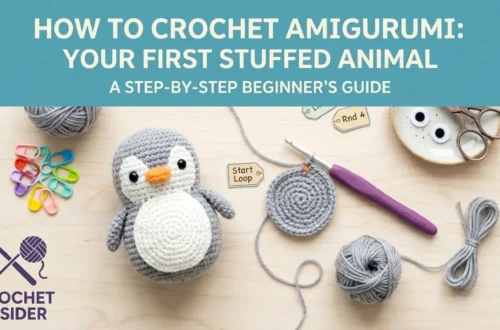
I still remember the day I learned my first chain stitch — sitting on my couch, hook in one hand, a tangled ball of yarn in the other, completely convinced I was doing it wrong. Spoiler: I wasn’t. And you won’t be either. Crochet has this magical quality where, once something finally “clicks,” you realize it’s been making perfect sense all along. This guide is everything I wish someone had handed me on day one.
What is crochet? (And why you’ll love it)
Crochet is a craft where you use a single hook to interlock loops of yarn into fabric. Unlike knitting, which uses two needles and keeps multiple live stitches open at once, crochet works with one active stitch at a time — which makes it much more forgiving for beginners and much harder to accidentally unravel.
The word comes from the French crochet, meaning “little hook.” And that little hook is truly all you need to create everything from cozy blankets and adorable amigurumi animals to stylish market bags and intricate shawls. I’ve seen beginners go from their very first chain stitch to completing a full wearable sweater in just a few months. The learning curve feels steep at first, then suddenly everything accelerates.
Why crochet beats other crafts for beginners
One hook, one yarn. No needles to juggle, no complicated setups.
Very easy to fix mistakes. Just pull the yarn and undo — no dropped stitches to chase.
You can see progress fast. Most beginners complete their first project within a weekend.
Incredibly versatile. The same basic stitches create completely different textures and projects.
It’s genuinely relaxing. There’s solid research linking repetitive hand crafts to reduced anxiety and better sleep.
Whether you want to make handmade gifts, build a creative hobby, or eventually sell your own patterns on Etsy — it all starts right here, with a hook and a slip knot.
Everything you need to get started
Here’s the good news: you don’t need much. Seriously. A hook, some yarn, and a pair of scissors will get you through your first month of crocheting. Once you’re hooked (pun very much intended), you can build out your kit from there.
🪝Crochet HookStart with a 5.0mm or 5.5mm aluminum hook. Ergonomic handles are a lifesaver once you’re crocheting for longer sessions.
🧶YarnWorsted weight (#4) in a smooth, light color. Avoid dark colors, textured yarns, or anything fluffy when you’re learning.
✂️ScissorsAny sharp scissors work. A small pair on a keychain is handy for crafting on the go.
🪡Yarn NeedleA blunt tapestry needle for weaving in your ends. Get a pack of assorted sizes.
📎Stitch MarkersLittle clips that mark your place in a pattern. You can use a piece of contrasting yarn in a pinch.
📏Tape MeasureEssential for checking gauge once you move beyond your first few projects.
Choosing your first yarn: the weight system explained
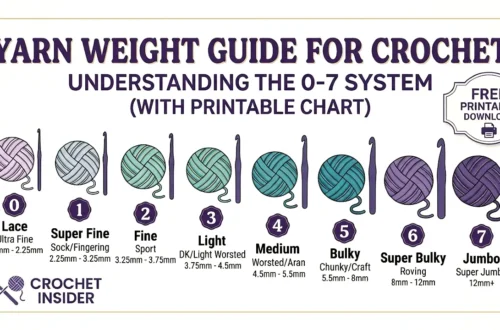
Yarn comes in different thicknesses, called weights, numbered from 0 (lace, extremely fine) to 7 (jumbo, extremely chunky). As a beginner, you want to stay in the sweet spot — not too thin, not too thick.
0LaceVery fine
1Super FineFingering
2FineSport
3LightDK
4MediumWorsted ← Start here!
5BulkyChunky
6Super BulkyRoving
7JumboMega
A worsted weight (#4) yarn is perfect for learning: the stitches are big enough to see clearly, but not so big that they feel unwieldy. Lion Brand Pound of Love, Caron Simply Soft, or Red Heart Super Saver are all affordable, beginner-friendly options you’ll find at any craft store. For more recommendations, see our → Best yarn for beginners: our full guide.
Hook sizes: a quick reference
Hook Size (mm)
US Size
Best For
Level
2.25mm
B-1
Lace, fine thread work
Advanced
3.5mm
E-4
DK weight yarn, lightweight projects
Intermediate
4.0mm
G-6
DK to worsted, amigurumi
Intermediate
5.0mm
H-8
Worsted weight — ideal for beginners
Beginner ✓
5.5mm
I-9
Worsted weight — great starter hook
Beginner ✓
6.0mm
J-10
Chunky yarns, blankets
Beginner friendly
9.0mm
M/N-13
Super bulky, quick projects
Beginner friendly
Pro tip: buy an ergonomic hook early
Standard aluminum hooks are perfectly fine for learning, but if you plan to crochet more than 20–30 minutes at a time, ergonomic hooks with a soft rubber grip make a huge difference. Brands like Clover Amour and Furls are beloved in the crochet community. Your hands will thank you later.
How to hold your hook and yarn
This is where a lot of beginners get frustrated — and completely unnecessarily so. There is no single “correct” way to hold a crochet hook. What matters is finding a grip that feels comfortable and gives you control over the yarn tension. That said, here are the two most common methods:
The Pencil Grip
Hold the hook like you’d hold a pencil, with your thumb and index finger resting on the flat part of the hook (called the thumb rest). The hook end points upward and away from you. Most beginners naturally gravitate toward this grip.
The Knife Grip
Hold the hook like a dinner knife — your hand rests on top of the hook and your thumb holds it against your index finger. This grip is often easier on the wrist during long sessions and is popular among people who crochet for hours at a time.
Don’t overthink the grip
Try both methods for a few minutes each and go with whichever feels more natural. Your grip will evolve over the first few weeks as your hands get used to the movement. I personally switched from pencil to knife grip about three months in and never looked back. Neither is wrong — I promise.
Managing yarn tension
Tension is how tightly or loosely the yarn runs through your fingers as you crochet. Even tension = even stitches = a beautiful finished piece. This is the thing that takes the most time to develop, and that’s completely normal.
The standard way to manage tension is to thread the yarn through the fingers of your non-dominant hand — typically over your index finger, under your middle finger, and over your ring finger. Your index finger “feeds” the yarn to the hook at a consistent pace. Experiment until you find something that keeps the yarn flowing smoothly without you having to constantly readjust.
Good news: you can make almost anything in crochet with just five stitches. Seriously. Blankets, bags, hats, stuffed animals, scarves — all built from variations of these fundamentals. Let’s walk through each one.
Before every stitch: the Slip Knot
1
Make a loopMake a loop with your yarn, crossing the working yarn (attached to the ball) over the tail end. Think of it like making a lowercase “e” shape.
2
Pull throughReach through the loop with your hook and grab the working yarn (the strand going to the ball). Pull it through the loop.
3
TightenPull both the tail and working yarn gently to tighten the knot around the hook. It should be snug but still able to slide along the hook.
The loop on your hook should never be so tight you can’t move the hook freely. If it’s tight, loosen it — you’ll have uneven tension throughout your work.
Stitch 1: Chain Stitch (ch)
The chain is the foundation of almost every crochet project. It’s literally just a series of connected loops.
1
Yarn over (YO)With your slip knot on the hook, wrap the working yarn over the hook from back to front. This is called “yarn over” (abbreviated YO in patterns).
2
Pull throughPull that yarn through the loop already on your hook. You’ve made one chain stitch! The loop remaining on your hook doesn’t count as a stitch.
3
RepeatKeep doing YO + pull through until you have a chain as long as you need. Practice making 20–30 chains in a row until they feel even and effortless.
Look at the front of your chain: you’ll see a row of V shapes. Each V is one chain stitch. Count them from here, not the loop on your hook.
Stitch 2: Slip Stitch (sl st)
The shortest of all crochet stitches — barely any height at all. Mostly used for joining rounds, moving across your work without adding height, or creating surface decoration.
1
Insert hookInsert your hook into the stitch (or chain) where you want to work the slip stitch. You should have two loops on your hook.
2
YO and pull through both loopsYarn over, then pull through BOTH loops on the hook in one motion. That’s it — one slip stitch made!
Stitch 3: Single Crochet (sc)
The single crochet is the backbone of beginner projects. It creates a dense, sturdy fabric — perfect for dishcloths, bags, and amigurumi. Once you can do this consistently, you’re officially a crocheter.
1
Insert hook, yarn over, pull up a loopInsert your hook into the next stitch. Yarn over and pull through the stitch only. You now have 2 loops on your hook.
2
Yarn over, pull through both loopsYarn over again and pull through BOTH loops. One single crochet complete!
New stitches always end with “YO, pull through last X loops.” Remembering that one principle will help you figure out almost every stitch in crochet.
Stitch 4: Half Double Crochet (hdc)
Slightly taller than single crochet, with a nice soft drape. Great for hats, cowls, and anything you want to feel cozy but not too stiff.
1
Yarn over firstBefore inserting the hook, yarn over. Then insert into the next stitch. Yarn over and pull up a loop. You now have 3 loops on your hook.
2
Pull through all 3Yarn over and pull through all 3 loops at once. Done! The extra yarn over before inserting is what gives this stitch its extra height and soft texture.
Stitch 5: Double Crochet (dc)
The most used stitch in crochet patterns. Twice the height of single crochet, it creates a looser, drapey fabric. This is the stitch you’ll see in granny squares, blankets, and most garments.
1
YO, insert hook, YO, pull up loopYarn over, insert hook into the stitch, yarn over again and pull up a loop. You now have 3 loops on your hook.
2
YO, pull through 2Yarn over and pull through the first 2 loops. Now you have 2 loops left on the hook.
3
YO, pull through remaining 2Yarn over once more and pull through the last 2 loops. One double crochet complete!
Double crochet rows start with a “turning chain” of 3 chains — this counts as your first dc and brings your work up to the right height for the row.
Practice tip: the swatch is your best friend
Before starting any real project, make a practice swatch: 20 chains, then rows of single crochet until you have a small square. It trains your hands, helps you feel comfortable with turning your work, and gives you a low-stakes space to make mistakes. I still make practice swatches when I try a new yarn or stitch pattern.
A dishcloth (or washcloth) is the classic first crochet project — and for good reason. It’s flat, rectangular, uses just one stitch, requires very little yarn, and gives you a genuinely useful finished object you’ll actually be proud of. Here’s a simple pattern using only single crochet:
Simple Beginner Dishcloth
Free Pattern
Yarn: Cotton worsted weight (#4) — about 50–70 yards
Hook: 5.0mm (H-8)
Finished size: ~20 x 20 cm (8 x 8 in)
Level: Absolute beginner
Abbreviations used
ch — chain
sc — single crochet
st(s) — stitch(es)
rep — repeat
t-ch — turning chain
FO — fasten off
Pattern
Setup:Chain 21. (This gives you 20 stitches to work into — the first chain doesn’t count.)
Row 1:Sc in 2nd chain from hook and in each chain across. (20 sc) Chain 1, turn.
Rows 2–20:Sc in each stitch across. (20 sc) Chain 1, turn.
Finish:After Row 20, do not turn. FO and weave in your ends with a yarn needle.
A note on “chain 1, turn”: At the end of each row, you chain 1 before turning your work. This is called the turning chain — it brings your work up to the correct height for the next row. For single crochet, the turning chain does NOT count as a stitch, so you’ll always have 20 stitches per row (not 21).
Once you’ve made this dishcloth, try making it bigger, or try working it in double crochet instead — you’ll see how drastically the fabric changes with just a stitch swap. Check out our → 10 best first crochet projects for beginners for more ideas once you’re done.
Loved this pattern? Join the Crochet Insider community — I’ll be sharing exclusive step-up beginner patterns, video walkthroughs, and monthly project bundles. Stay tuned for when we launch! 🧶
Common beginner mistakes (and how to fix them)
Every crocheter makes these mistakes. Every single one of us. The difference between a beginner who sticks with it and one who gives up is knowing that these problems are completely normal and very fixable.
📐
Your work is getting wider or narrower as you goYou’re accidentally adding or skipping stitches at the beginning or end of each row. This is the #1 beginner problem.Fix: Use a stitch marker in your very first and last stitch of each row. Count your stitches at the end of each row until it becomes automatic.
🪢
Your stitches are too tight to work intoYou’re crocheting with too much tension, making the loops on your hook tiny and hard to insert into.Fix: Consciously slow down and try to keep your loops a bit looser. Going up a hook size (e.g., from 5mm to 5.5mm) can also help your tension relax naturally.
🔢
You keep miscounting your chainsThe loop on your hook doesn’t count as a chain, and the first stitch you work into isn’t always chain 1. This trips everyone up.Fix: Count your chains as you make them, placing a stitch marker every 10 chains for long foundation chains. Re-read the pattern’s starting instruction carefully.
🔀
Your work is twisting or curlingFor single crochet, some curling at the foundation row is completely normal and blocks out (see below). Consistent twisting usually means you’re working into the wrong part of the stitch.Fix: Make sure you’re inserting your hook under BOTH loops of the stitch (unless the pattern says otherwise). One loop only creates a different effect called “back loop only” (BLO).
🧵
You can’t figure out where the stitches areEspecially common with dark yarn or textured/fluffy yarn, where the structure is hard to see.Fix: Switch to a smooth, light-colored worsted weight yarn for practice. You’ll be able to see your stitches clearly and build muscle memory before tackling trickier yarns.
If you’re struggling with something specific, chances are there’s a solution. Browse our crochet troubleshooting guide for fixes to the most common problems beginners run into.
How to read a crochet pattern
Crochet patterns look intimidating at first — full of cryptic abbreviations and mysterious asterisks. But once you know the code, they’re really just a set of instructions written in shorthand. Let me break it down.
Common crochet abbreviations (US terminology)
ch — chain
sl st — slip stitch
sc — single crochet
hdc — half double crochet
dc — double crochet
tr — treble crochet
inc — increase (2 sts in 1)
dec — decrease (2 sts into 1)
sk — skip (a stitch)
sp — space
rep — repeat
BLO — back loop only
FLO — front loop only
MR — magic ring
YO — yarn over
FO — fasten off
Important note: There are two crochet terminologies — US and UK. They use the same words for completely different stitches. A “double crochet” in UK terms is a “single crochet” in US terms. Always check which terminology a pattern uses before you start. Most online patterns and all Crochet Insider patterns use US terminology.
What do asterisks and brackets mean?
Asterisks (*) and square brackets ([ ]) indicate a section of stitches that gets repeated. For example: *sc in next 3 sts, ch 2* rep 4 times means you do that whole sequence four times in total. Parentheses at the end of a row — like (20 sc) — tell you how many stitches you should have after completing that row. Always check this number; it’s your best friend for catching mistakes early.
Most people can complete a simple project within their first weekend of learning. Basic stitches (chain, single crochet, double crochet) can be picked up in a few hours of practice. Feeling truly comfortable — where crocheting feels automatic and relaxing rather than concentration-heavy — typically takes 4–8 weeks of regular practice. “Regular” means even just 20–30 minutes a day. Consistency matters much more than long sessions.
Is crochet or knitting easier to learn?
Most beginners find crochet easier to pick up. With crochet you only manage one live stitch at a time (vs. a full needle of stitches in knitting), mistakes are much easier to undo, and the hook is more intuitive to control than two needles. That said, knitting produces different textures and garments that many people prefer, so the “easier” craft is also the one that matches what you most want to make.
Can I teach myself crochet from YouTube?
Absolutely — and millions of people have. YouTube is honestly one of the best resources for learning crochet because you can watch someone’s hands in real time, pause, and replay as many times as you need. Channels like Bella Coco Crochet, Jayda InStitches, and TL Yarn Crafts are excellent for beginners. Combine video tutorials with written guides (like this one!) for the best results.
What’s the difference between US and UK crochet terms?
The same stitch names mean different things in US vs. UK terminology, which causes enormous confusion. The main difference: what the US calls “single crochet (sc)” the UK calls “double crochet (dc),” and what the US calls “double crochet (dc)” the UK calls “treble crochet (tr).” Always check which system your pattern uses. At Crochet Insider, we always use US terminology and label it clearly in every pattern.
Why does my crochet curl up at the edges?
Some curling, especially at the foundation chain row, is completely normal with single crochet worked flat. It usually evens out once you have a few rows done, and it completely disappears after blocking (wetting your finished piece and pinning it flat to dry). If your whole project curls significantly, you may be crocheting too tightly — try going up half a hook size or consciously relaxing your tension.
How much yarn do I need for my first project?
The dishcloth pattern in this guide uses about 50–70 yards of worsted weight yarn — that’s less than half a standard skein. Most beginner-friendly yarn comes in 200–250 yard skeins, so one skein is plenty to make 3–4 practice swatches AND your first project. For larger projects like a hat (~100 yards) or a baby blanket (~500–800 yards), yarn amounts scale up considerably. Every pattern will tell you exactly how much yarn you need.
You’ve got the basics — what now?
Once you’re comfortable with chains and single crochet, the whole crochet world opens up. Here’s where I’d suggest heading next: