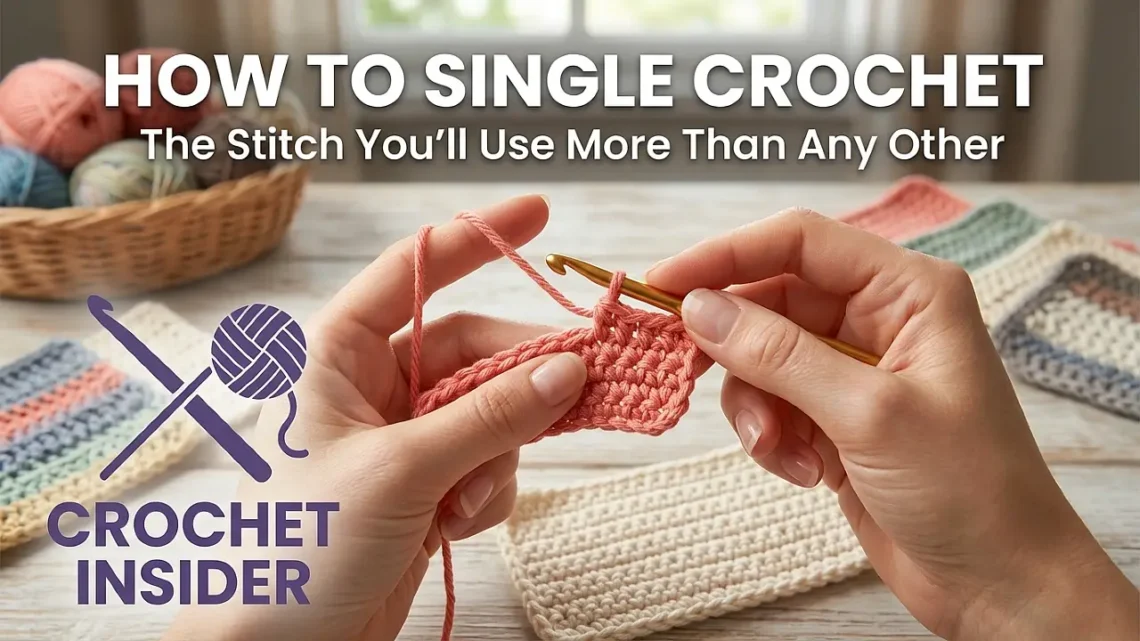
The single crochet is the workhorse of the crochet world. It’s the stitch you’ll use in almost every project – dishcloths, amigurumi, hats, blankets, bags. It’s short, dense, and sturdy. When I teach someone to crochet, after the chain, single crochet is the first “real” stitch they learn. And once you master it, you’ve unlocked the ability to make a huge range of items. In this guide, I’ll show you exactly how to make a single crochet stitch, how to work into a foundation chain, how to turn rows, and how to fix common mistakes. Plus, I’ll give you 10 projects that use nothing but single crochet – so you can practice and make something beautiful at the same time.
What is single crochet? (And why it’s so useful)
Single crochet (abbreviated “sc”) is the shortest of the main crochet stitches. It creates a dense, firm fabric with a relatively stiff drape. Here’s why you’ll use it constantly:
- Amigurumi – almost entirely single crochet, worked in the round with tight tension.
- Dishcloths and washcloths – the dense fabric is perfect for scrubbing.
- Bags and baskets – single crochet holds its shape beautifully.
- Hats and blankets – especially when you want a warm, thick fabric.
- Borders and edgings – a single crochet border cleans up uneven edges.
If you can chain and single crochet, you can already make a huge number of projects. The rest is just variations and combinations.
Step‑by‑step: how to single crochet
Let’s walk through the single crochet stitch slowly. You’ll need a hook and yarn, and you should already have a foundation chain (see our chain stitch guide if you haven’t done that yet).
That’s it. To make another single crochet, repeat steps 1‑5 in the next chain. Keep going until you reach the end.
Working single crochet into a foundation chain
When you work into a foundation chain, you have to decide where to insert your hook. The standard is under both top loops of the chain V. This creates a neat, firm edge.
Important: The first chain from the hook is always skipped. So if you chain 21, you’ll single crochet in chains 2 through 21. That gives you 20 single crochets. Patterns will say “sc in 2nd ch from hook” – that’s what they mean.
Some patterns call for working into the “back bump” of the chain (the ridge on the back). That creates a stretchier, more decorative edge. But for now, stick with the standard method (both top loops).
Turning rows: how to start a new row of single crochet
After you finish a row, you need to turn your work and start the next row. Here’s how:
Remember: the turning chain does not count as a stitch
This is different from double crochet (where the turning chain counts). In single crochet, you always chain 1, then skip that chain and work into the first stitch. If you accidentally work into the turning chain, you’ll gain an extra stitch each row and your project will get wider.
Tension tricks for even single crochet
Uneven tension is the #1 frustration with single crochet. Here’s how to get those neat, uniform stitches.
- Don’t pull too tight after each stitch. Let the hook determine the loop size – the shaft of the hook is your “ruler.”
- Watch your yarn hand. The yarn should glide through your fingers, not be strangled. Practice holding the yarn with a relaxed tension.
- Use a hook that’s the right size. If your single crochet feels stiff and hard, go up a hook size. If it’s loopy and loose, go down.
- Count your stitches after each row. If the count changes, you’ve added or dropped a stitch. Fix it immediately.
9 common single crochet mistakes (and fixes)
Single crochet variations: BLO, FLO, reverse sc
Once you’ve mastered basic single crochet, try these easy variations to create texture.
Back loop only (BLO)
Instead of inserting under both loops of the V, insert only under the back loop (the loop farther from you). This creates a horizontal ridge on the front of your work. It’s used for ribbing on hats and cuffs.
Front loop only (FLO)
Insert under the front loop (the loop closer to you). Creates a ridge on the back. Less common but useful for certain patterns.
Reverse single crochet (crab stitch)
This is single crochet worked backwards – from left to right (if you’re right‑handed). It creates a twisted rope edge, perfect for borders. To do it: after finishing a row, don’t turn. Instead, insert your hook into the stitch to the right, yarn over, pull up a loop, yarn over, pull through both loops. It’s awkward at first but very effective.
For a full tutorial on BLO and crab stitch, see our single crochet variations guide.
10 projects you can make with only single crochet
You don’t need fancy stitches to make beautiful things. Here are 10 projects that use only single crochet (and chains).
Single Crochet Project Ideas
All sc onlyStart with the dishcloth – it’s small and useful. Then try the scarf or the baby blanket. By the time you finish those, your single crochet will be beautifully even.
Practice swatch pattern
Here’s a simple swatch to practice your single crochet. Make it, then unravel and make it again until your stitches look even.
Single Crochet Practice Swatch
PracticeYou’ve got the most important stitch down
Single crochet is the foundation of so many projects. Once you’re comfortable with it, you’re ready for double crochet, half double crochet, and the rest. But don’t rush – spend a week making dishcloths and small squares. Your hands will thank you when you move on to bigger projects.