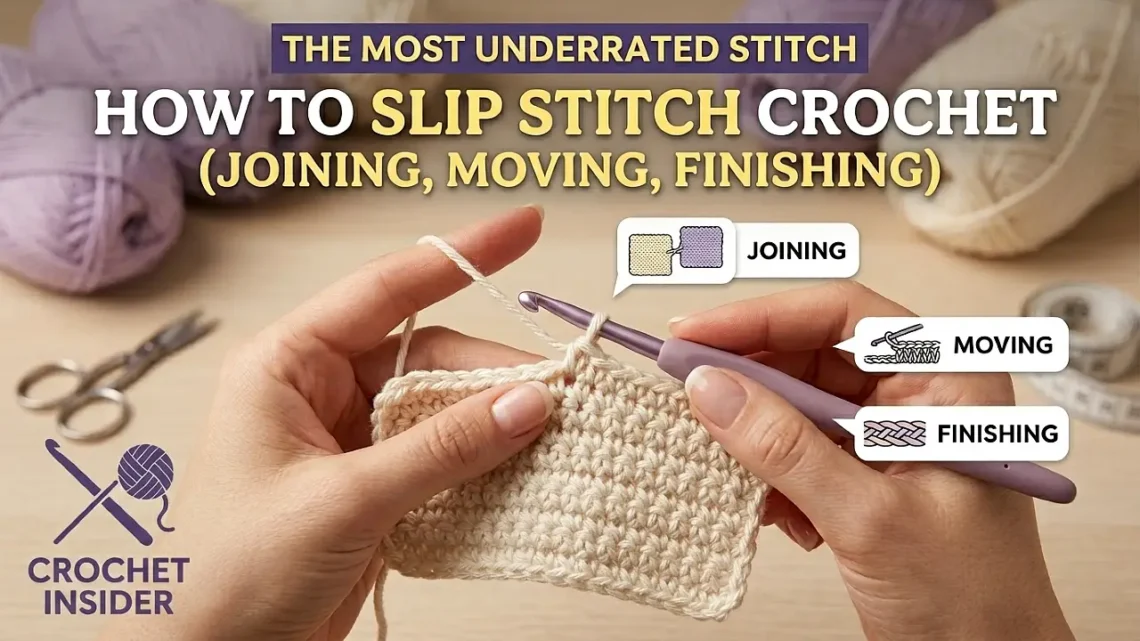
The slip stitch is the wallflower of crochet. It never gets the spotlight – single crochet, double crochet, even half double gets more love. But slip stitch is the quiet hero that holds everything together. It’s what you use to join rounds, to move across your work without adding height, to create invisible seams, and to add decorative ridges. I used to skip over slip stitch instructions, but once I learned how powerful it really is, I started using it all the time. In this guide, I’ll teach you exactly how to make a slip stitch, the many ways to use it, common mistakes, and even 5 projects that rely on slip stitch. Let’s give this underrated stitch the attention it deserves.
What is a slip stitch? (The shortest stitch)
The slip stitch (abbreviated “sl st”) is the shortest of all crochet stitches. It has almost no height. It’s used to:
- Join rounds: At the end of a round in joined‑round crochet, you slip stitch into the first stitch to close the round.
- Move across stitches: If you need to get from one point to another without adding height, slip stitch across.
- Seam pieces together: Slip stitch through both layers creates a flat, strong seam.
- Decorative surface crochet: Work slip stitches on top of finished fabric to create lines and patterns.
- Ribbing: Working slip stitches in the back loop creates a stretchy, knit‑like fabric.
Unlike single crochet, which adds height, slip stitch is essentially just a connector. It’s fast, simple, and essential.
Step‑by‑step: how to slip stitch
Let’s walk through the slip stitch. You’ll need a hook and some practice fabric (or just a chain).
That’s it. One slip stitch made. Practice by making a chain, then slip stitch in each chain back to the beginning. Notice how flat the fabric becomes – it doesn’t add height, it just creates a dense, firm edge.
Joining rounds: the slip stitch join
If you’re working in joined rounds (as opposed to continuous spirals), you’ll end each round with a slip stitch to close it. Here’s how:
After completing the last stitch of the round, insert your hook into the top of the first stitch of the round (or the turning chain). Yarn over and pull through both the stitch and the loop on your hook. The round is now closed. Then you chain the required number (e.g., ch 1 for sc, ch 3 for dc) to start the next round.
Why this matters: The slip stitch join creates a clean, invisible closure. If you don’t join, you’ll be working in a spiral (which has its own uses). The slip stitch join is essential for granny squares, hats worked from the brim up, and many doily patterns.
Moving across work (without adding height)
Sometimes a pattern will tell you to “slip stitch to the next ch‑2 space” or “slip stitch across 5 stitches.” This means you’re moving your working loop to a new position without adding height. It’s common in lace patterns and granny squares.
For example, in a granny square, after you join a round, you often slip stitch across the next few stitches until you reach a corner chain space. Then you start the next round from there. This keeps the corner neat and prevents a visible seam.
Tip: When slip stitching across, keep your tension loose. Tight slip stitches can pucker the fabric.
Invisible seaming with slip stitch (mattress stitch alternative)
You can use slip stitch to seam two pieces together – for example, the sides of a sweater or the edges of a pillow cover. There are two methods:
- Slip stitch through both layers: Hold the two pieces with right sides together (or wrong sides together, depending on the desired finish). Insert the hook through both layers, yarn over, and pull through both layers and the loop. This creates a visible but flat seam. Strong and fast.
- Mattress stitch (invisible): For an invisible seam that’s almost undetectable from the right side, use a tapestry needle and whipstitch. But slip stitch gives a decorative ridge – sometimes that’s exactly what you want.
For seaming granny squares, slip stitch join is very popular. Place two squares with right sides together, insert hook through both loops of both squares, and slip stitch across. The seam will be flat and slightly textured.
Surface slip stitch (crochet embroidery)
Surface slip stitch is a technique where you work slip stitches on top of finished crochet fabric to create lines, outlines, or lettering. It’s like drawing with yarn.
How to do it: Attach yarn to the fabric by pulling a loop through from the back (use a hook or a needle to pull the yarn through at the starting point). Then, insert the hook a short distance away, pick up the yarn, and pull through both the fabric and the loop. Continue to create a dashed line. The effect is a slightly raised chain that sits on top of the fabric.
Use surface slip stitch to:
- Outline a granny square or heart
- Write words on a blanket or bag
- Add decorative stripes to a hat
- Fake a “knitted” look
It takes practice to keep the tension even, but it’s a fun way to personalise projects.
Slip stitch ribbing (makes a stretchy fabric)
Working slip stitches in the back loop only (BLO) creates a surprising amount of stretch – more than single crochet ribbing. It’s great for hat brims, cuffs, and sweater hems.
How to make slip stitch ribbing: Chain the desired number of stitches (e.g., 10 for a cuff). Row 1: Slip stitch in the 2nd chain from hook and each chain across. Ch 1, turn. Row 2: Slip stitch in BLO of each slip stitch across. Ch 1, turn. Repeat row 2 for the desired length.
The resulting fabric is dense, squishy, and incredibly stretchy. I use this for the brims of winter hats – it hugs the head without needing elastic.
5 common slip stitch mistakes (and fixes)
Practice projects using slip stitch
Here are 5 ways to practice slip stitch in real projects:
- Slip stitch ribbed headband – Chain 8, sl st BLO for 50 rows. Sew ends together. Fast.
- Surface slip stitch mug cozy – Make a simple rectangle. Use surface slip stitch to write “COFFEE” or draw a heart.
- Granny square join – Make 4 granny squares. Join them with slip stitch (right sides together).
- Slip stitch hat brim – Make a basic beanie, then add a slip stitch BLO brim instead of single crochet.
- Invisible seam on a pillow cover – Seam the edges with slip stitch for a decorative ridge.
Once you get comfortable, you’ll find yourself reaching for slip stitch more often. It’s the stitch that quietly makes everything better – joining, moving, seaming, and decorating. Don’t underestimate it.