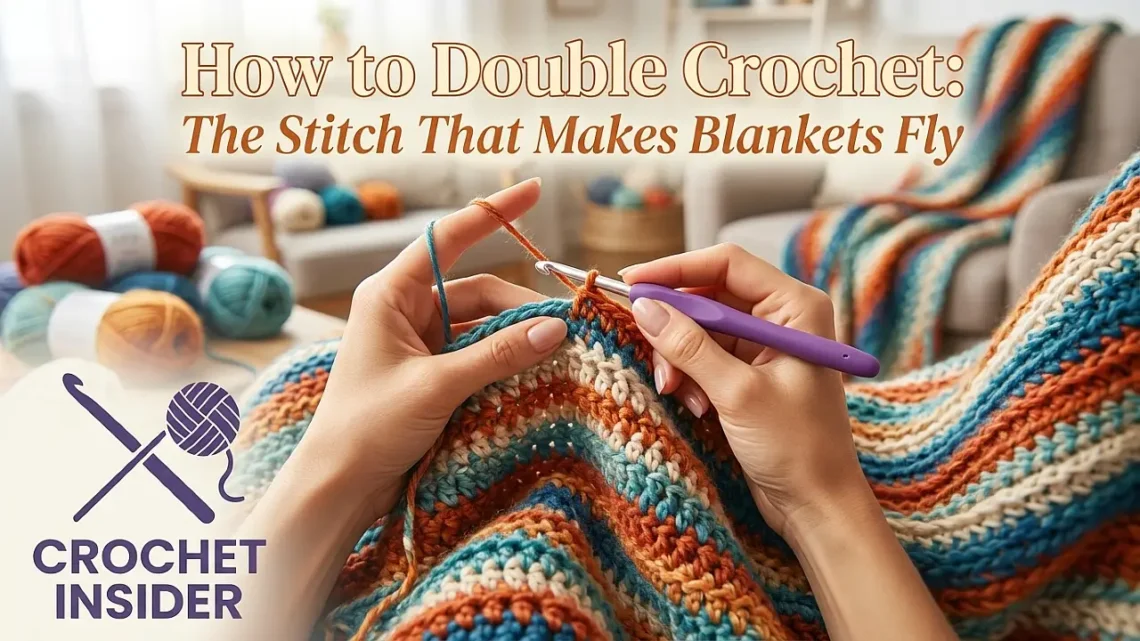
I remember the first time I learned double crochet. After weeks of single crochet dishcloths, double crochet felt like magic. Suddenly, my rows were twice as tall. Blankets that would have taken a month now took a weekend. Double crochet (abbreviated “dc”) is the stitch you’ll use for blankets, shawls, sweaters, and granny squares. It’s taller, looser, and faster than single crochet. In this guide, I’ll teach you how to make a perfect double crochet stitch, how to turn rows correctly (the turning chain counts as a stitch – different from single crochet!), and how to avoid the most common mistakes. Plus, 10 projects that use only double crochet, so you can practice until it becomes second nature.
What is double crochet? (Why it’s a game changer)
Double crochet is the second most common stitch after single crochet. It’s about twice as tall as single crochet, which means:
- You work up projects twice as fast. A blanket that would take 100 rows of single crochet takes only 50 rows of double crochet.
- The fabric is softer and drapier. Double crochet creates more open space between stitches, making it perfect for blankets, shawls, and garments.
- It’s the foundation of granny squares. Granny squares are made of clusters of double crochet.
You’ll see double crochet in almost every pattern: blankets, scarves, hats, sweaters, cardigans, bags, and lace. Once you master it, you can make a huge range of projects.
Step‑by‑step: how to double crochet
Let’s walk through the double crochet stitch slowly. You’ll need a hook and yarn, and you should already have a foundation chain (see our chain stitch guide if you need a refresher).
To make another double crochet, repeat steps 1‑5 in the next stitch. Keep going until you reach the end of the row.
Working double crochet into a foundation chain
When you work your first row of double crochet into a chain, you need to skip the first 3 chains. Why? Those 3 chains become the “turning chain” and count as the first double crochet of the row.
The rule: If you chain 21, you will double crochet in the 4th chain from the hook, then each chain after that. That means you’ll have 18 double crochets + the turning chain = 19 double crochet stitches total in the row.
Patterns will say: “Ch 21, dc in 4th ch from hook and each ch across.” That’s your cue.
When you insert your hook into the chain, go under both top loops of the V (the same as single crochet). This creates a neat, firm edge.
Turning rows: the turning chain counts as a stitch
This is where double crochet differs from single crochet. For single crochet, the turning chain (ch 1) does NOT count as a stitch. For double crochet, the turning chain (ch 3) DOES count as a stitch.
Remember: chain 3 = first dc
Because the turning chain counts, you will always have the same number of stitches per row (the turning chain + your dc stitches). If you forget to skip the first stitch, you’ll gain an extra stitch each row.
How to count double crochet stitches (including the turning chain)
Counting double crochet rows can be confusing because the turning chain looks different from a regular dc. Here’s how to do it:
- To count stitches in a row: Look at the top of each stitch – each double crochet looks like a V, just like single crochet, but taller. Count the V’s, and include the turning chain at the beginning of the row. It might look like a sideways V, but it counts as a stitch.
- To count rows: Look at the posts of the double crochets. Each row’s posts will lean slightly in one direction. Count the horizontal lines of posts. Or use a row counter.
For a visual guide, see our article on counting stitches and rows.
Tension tricks for even double crochet
Double crochet is more forgiving of tension than single crochet, but still practice these tips:
- Don’t pull the yarn tight after each stitch. Let the hook determine the size of the loops.
- Keep the loops on the hook at a consistent height. When you pull up a loop after inserting, bring it up to the same height as the previous stitches.
- If your fabric is stiff and tight, go up a hook size. Double crochet should have a soft drape.
- If your fabric is loose and holey, go down a hook size. You don’t want huge gaps (unless you’re making lace).
9 common double crochet mistakes (and fixes)
Double crochet variations: front post, back post, linked
Once you’ve mastered basic double crochet, try these variations for texture and design.
Front post double crochet (FPdc)
Instead of inserting into the top of the stitch, you insert your hook from front to back to front around the vertical post of the stitch below. Complete the dc as normal. This pushes the stitch forward, creating a raised ridge – used for cables and basketweave.
Back post double crochet (BPdc)
Same as FPdc, but you insert from back to front around the post. This pushes the stitch backward, creating a recessed ridge.
Linked double crochet (Ldc)
A variation that eliminates the gap between stitches, creating a denser fabric. After the first dc, you insert your hook into the horizontal bar of the previous dc instead of chaining. More advanced, but great for bags.
For full tutorials on post stitches, see our FPdc and BPdc guide.
10 projects you can make with only double crochet
Double crochet is fast, versatile, and perfect for these projects.
Double Crochet Project Ideas
All dc onlyStart with the fast blanket or the granny square. Both are classic, satisfying projects that will build your confidence.
Practice swatch pattern
Here’s a simple swatch to practice your double crochet. Make it, then unravel and make it again until your stitches look even and your edges are straight.
Double Crochet Practice Swatch
PracticeYou’ve mastered double crochet – now the world opens up
With chain, single crochet, and double crochet, you can make almost anything. Blankets, hats, scarves, bags, granny squares – all are within your reach. From here, you can explore half double crochet, treble crochet, shells, puffs, and cables. But take a moment to celebrate: double crochet is a major milestone.
Now go make something wonderful.