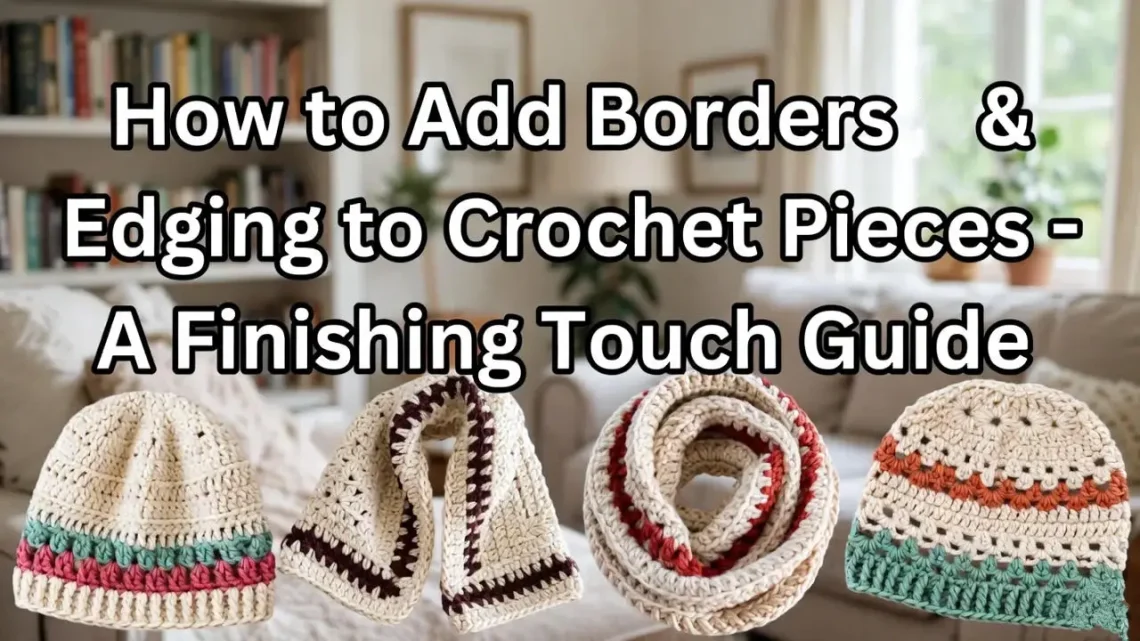
You’ve bound off the last stitch of your blanket, scarf, or garment. It’s beautiful, but something feels… unfinished. The edges might be slightly wobbly, or the piece lacks that polished, “ready-for-prime-time” look. I used to consider borders optional, until I added a simple shell stitch edge to a basic baby blanket. It transformed it from a nice handmade item into a gorgeous heirloom gift. The border became the star.
A well-chosen border is more than just decoration; it’s a functional and design-critical finish. It stabilizes edges, corrects minor unevenness, adds weight and drape, and defines the shape of your piece. It’s the frame that completes the painting. But choosing the wrong border can overwhelm a delicate piece or look tacked-on. In this guide, I’ll teach you how to select a border that complements your stitch pattern, how to prepare your edges for a smooth application, and walk you through several classic edgings with step-by-step instructions. You’ll learn to calculate stitch counts for a perfect fit and how to turn corners neatly. Let’s give your projects the flawless finish they deserve.
Part 1: The “Why” – What a Border Actually Does
- Corrects & Stabilizes: Even with perfect tension, edges can ripple or pull. A border can tame this, squaring up your project and giving it a crisp outline.
- Adds Professional Polish: It covers the sometimes messy starting chain and final row, giving a complete, intentional look.
- Enhances Design: A border can pick up a color from within the piece, highlight a texture, or add a contrasting pop.
- Provides Weight & Drape: A few rounds of border add a subtle weight to blankets and shawls, helping them lie flat and drape beautifully.
- Protects Edges: On frequently used items like blankets or dishcloths, a sturdier border reinforces the most vulnerable part of the fabric.
Part 2: Preparing Your Edge – The Key to a Smooth Border
You can’t build a straight house on a crooked foundation. Before you pick up your hook for the border, do this:
- Block Your Piece: Always block your project first. This sets the stitches and evens out the edges, making it infinitely easier to work into them evenly.
- Create a Foundation Round: For many projects, especially those with uneven edges (like granny squares or textured stitches), I highly recommend a foundation round of single crochet (sc).
- Use the same hook size or one slightly smaller.
- Work 1 sc in each stitch across straight edges.
- At corners, work (sc, ch 1, sc) in the corner stitch or space.
- For curved edges or spaces, work a consistent number of sc (e.g., 3 sc in every corner space, 1 sc in every other stitch on a curve) to keep the edge flat.
- Weave in Ends: Please, weave in your ends before adding the border. It’s much harder to do it neatly afterwards.
Part 3: Mastering the Corner Turn
This is what separates a homemade border from a professional one. To prevent a border from ruffling or pulling, you must add extra stitches at each corner to allow it to turn the 90-degree angle smoothly.
The Universal Corner Formula: For most basic borders (sc, hdc, dc), work (stitch, chain, stitch) in the corner stitch or space.
Example for a single crochet border: When you reach the corner stitch, work (1 sc, ch 1, 1 sc) all into that same stitch. The chain gives the corner the necessary “ease” to lie flat.
For fancier borders like shells, the corner is often a larger cluster, like (shell, chain, shell).
Part 4: 5 Classic Borders to Master (From Simple to Show-Stopping)
1. The Simple Single Crochet (SC) Border
Best for: A clean, modern, understated frame. Great for graphic blankets, garments, and items that don’t need frills.
How-To: Work 1 sc in each st around, placing (sc, ch 1, sc) in each corner. For a thicker line, work 2 or 3 rounds. Using a contrasting color for the final round creates a sharp “piping” effect.
2. The Crab Stitch (Reverse Single Crochet)
Best for: A beautiful, rounded, rope-like edge. It looks intricate but is easy once you get the backwards motion. Excellent for dishcloths, coasters, and blanket edges.
How-To: Unlike normal crochet, you work from left to right (if right-handed). Insert hook in stitch to the right, yarn over, pull loop through, yarn over, pull through both loops. It creates a lovely twisted cord effect. It’s typically only one round, as it’s quite dense.
3. The Picot Edge
Best for: A delicate, feminine, lacy finish. Perfect for baby items, handkerchiefs, lace shawls, and the edges of sleeves.
How-To: There are many variations. A common one: *Sc in next 2 sts, (ch 3, sl st in top of last sc made – this forms the picot point); repeat from * around. The picots are little decorative bumps or points.
4. The Shell Stitch Border
Best for: A romantic, vintage, or ultra-feminine look. Adds significant visual weight and texture. Stunning on blankets and shawl edges.
How-To: A classic shell is (2 dc, ch 1, 2 dc) all in the same stitch. You’d typically skip a few stitches between shells. For a corner, you might do a larger shell or two shells separated by chains. This border can be a wide, dramatic statement.
5. The Granny Stitch Border
Best for: Blankets, especially those made from granny squares. It extends the motif’s aesthetic seamlessly.
How-To: It’s worked in clusters of doubles separated by chains, just like a granny square round. It’s airy, quick, and integrates perfectly with granny-style projects.
Part 5: How to Calculate Stitch Counts for a Perfect Fit
The worst feeling is starting a border and having it ruffle or pucker because your stitch count is off. Here’s how to avoid it:
- After your foundation sc round, count the total number of stitches. Let’s say you have 200 stitches total.
- Your decorative border pattern will have a repeat (e.g., Shell repeat over 5 stitches: Shell in next st, sk 2, sc in next 2).
- Ensure your total stitch count is a multiple of your repeat. If your repeat is 5 stitches, 200 is a perfect multiple (200 / 5 = 40). You can work the repeat 40 times around.
- If your count is NOT a multiple: You need to adjust slightly on the foundation round. Add or subtract a few single crochets evenly across the straight edges (not at the corners!) to reach a divisible number. A difference of 1-2 stitches can usually be fudged by working 2 sc in one space or skipping a stitch imperceptibly on a long edge.
Part 6: My Border Selection Checklist
Ask these questions before choosing:
- What’s the project’s style? Modern? Use clean lines (sc, crab stitch). Vintage? Use shells or picots.
- What’s the fiber? Stiff cotton can handle a dense crab stitch. Drapey wool might be better with a light shell.
- How much time do I have? A simple sc border is fast. An intricate lace edging is a project in itself.
- Does it need to lie flat? For blankets, always do a test swatch of your corner. If it curls, add more chains at the corner.
- Will it be used hard? For play blankets or dishcloths, choose a sturdy border like sc or hdc, not delicate picots.
Don’t be afraid to experiment. Make a small swatch of your main fabric and try different borders on it. See how they look and behave. The border is your final creative decision, the signature that says, “This is complete, and I considered every detail.” Take pride in it.
Frame Your Skills Further:
- First Step: Blocking for Perfectly Straight Edges – Essential prep work.
- Lace Inspiration: Beautiful Stitches for Edgings – For delicate borders.
- Classic Beauty: Shell Stitch Patterns & Variations – Master this popular border.
- The Finale: Weaving in Ends on a Multi-Round Borde