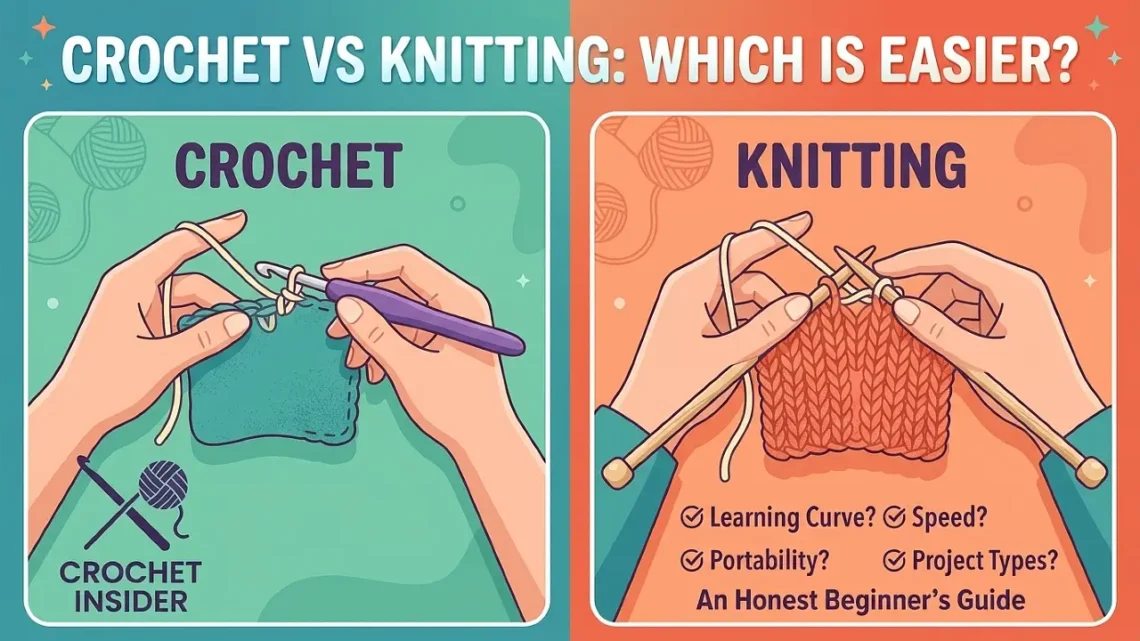
I learned to crochet first. Then, five years later, I taught myself to knit. And let me tell you that first knitting project – a garter stitch scarf – felt like learning to walk all over again. My hands were confused, the needles felt clumsy, and I kept trying to “yarn over” like I was crocheting. But I stuck with it, and now I do both. People ask me all the time: “Which is easier?” The honest answer: it depends on you. In this guide, I’ll compare crochet and knitting in every way that matters – cost, difficulty, speed, project types, fixing mistakes, and hand comfort. By the end, you’ll know which one to learn first (or if you should learn both).
Tools: hook vs needles – what’s easier to handle?
The biggest physical difference: crochet uses one hook. Knitting uses two needles (or sometimes one circular needle).
Crochet: one tool
You hold the hook in your dominant hand and the yarn in the other. That’s it. You manage one live loop at a time. If you drop your hook, the work doesn’t unravel immediately. For many beginners, managing one tool instead of two feels much less intimidating.
Knitting: two needles (or one circular)
You hold a needle in each hand, with multiple live stitches on both. Dropping a needle can cause stitches to slip off. It takes time to coordinate both hands. However, many people find the rhythm of knitting – rocking the needles – very soothing once they get it.
Winner for ease of tools: Crochet. One hook is simpler to manage than two needles, especially for absolute beginners.
Learning curve: which is faster to pick up?
This is personal, but data from craft surveys and my own teaching experience show a pattern.
| Factor | Crochet | Knitting |
|---|---|---|
| First hour of practice | Most people can make a chain and a few single crochets. | Most people can make a slip knot and a few knit stitches, but often drop stitches. |
| First project | Dishcloth (1‑2 hours) | Garter stitch scarf (several hours to days) |
| Mistake recovery | Easy – just pull the yarn to unravel. | Harder – picking up dropped stitches requires learning techniques. |
| Stitch complexity | Basic stitches are easy to memorize (sc, dc). | Knit and purl are simple but require switching hand positions. |
In my experience teaching both, complete beginners usually make their first crochet project in one sitting. Knitters often need a few sessions before they have a rectangle they’re proud of.
Winner for learning speed: Crochet. You’ll finish something you recognize faster.
Fixing mistakes: ripping back vs tinking
This is where crochet really shines.
In crochet: You only have one live stitch. If you make a mistake a few rows back, you can simply pull the yarn to unravel (“frog”) back to that point. Then redo. It’s mindless and fast.
In knitting: You have many live stitches. Unraveling (“ripping back”) means you have to catch all those stitches again on the needle. Or you “tink” (knit spelled backward) – unknit one stitch at a time. It’s slow and requires concentration.
Real talk
I’ve frogged (ripped out) entire crochet blankets in 30 seconds. I’ve spent 20 minutes tinking back 3 rows of knitting. Crochet is infinitely more forgiving for mistakes. That alone makes it easier for beginners, who make a lot of mistakes (we all did).
Winner for mistake recovery: Crochet by a landslide.
Speed: which craft is faster?
This depends on the stitch, but generally:
- Crochet stitches are taller. Single crochet is short, but double crochet and treble crochet add height quickly. A double crochet row covers the same vertical space as 2‑3 knit rows.
- Knitting produces a denser fabric. Stockinette stitch is relatively short. To get the same height as a crochet double crochet, you’d need multiple knit rows.
For blankets, crochet is usually faster. For garments like sweaters, experienced knitters can be very fast (continental knitting especially), but beginners will find crochet faster because of the taller stitches.
Winner for speed: Crochet, especially for blankets and accessories.
Project types: what you can make with each
Both crafts can make almost anything, but each has traditional strengths.
Crochet excels at:
- Blankets (works up fast, great drape)
- Amigurumi (stuffed toys – crochet is far better for 3D shapes)
- Dishcloths and market bags (firm, textured fabric)
- Lace and doilies (freeform)
- Granny squares (iconic)
- Hats and scarves (quick projects)
Knitting excels at:
- Sweaters and cardigans (superior drape and stretch)
- Socks (finer gauge, elasticity)
- Cables (knit cables are more defined than crochet post stitches)
- Lightweight garments (finer yarns)
- Colorwork (stranded knitting is unique)
That said, you can crochet a sweater and knit a blanket. Neither craft is limited. But if you want to make amigurumi, learn crochet. If you want to make socks, learn knitting.
Winner: Tie – depends on what you want to make.
Cost: supplies and yarn usage
Initial investment: Both are cheap to start. A basic aluminum crochet hook costs $2‑5. A pair of knitting needles costs about the same. You can buy both for under $10.
Ongoing cost: Crochet uses more yarn per square inch than knitting because the stitches are thicker and taller. A crochet blanket might need 30‑40% more yarn than a knit blanket of the same size. If you’re on a budget, knitting can be more economical over time.
Winner for low startup cost: Tie. Winner for lower yarn consumption: Knitting.
Hand pain and ergonomics
Both crafts can cause repetitive strain, but the pain patterns differ.
- Crochet – tends to stress the wrist of the hook hand (from twisting) and the yarn‑holding hand from tension. Ergonomic hooks help a lot.
- Knitting – can cause shoulder and elbow tension from holding both arms up. Continental knitting (yarn in left hand) is often more ergonomic than English (yarn in right).
Many people find crochet more comfortable for short sessions, but knitting can be easier on the hands for very long sessions because the motion is more symmetrical. This is highly individual.
Winner: Subjective – try both and see what hurts less for you.
Portability: which is easier to take on the go?
Crochet wins here. One hook, one ball of yarn, and you only have one live loop. You can shove a crochet project in a bag and not worry about stitches falling off. Knitting requires keeping those live stitches on the needles – point protectors help, but it’s still fussier.
Winner for portability: Crochet.
Final verdict: which should you learn first?
Here’s my honest recommendation based on who you are:
Learn crochet first if:
- You want to finish your first project in one evening.
- You’re afraid of making mistakes (crochet is far more forgiving).
- You want to make amigurumi, blankets, or dishcloths.
- You only want to buy one tool.
- You like the look of textured, chunky fabric.
Learn knitting first if:
- You dream of making sweaters or socks.
- You prefer a finer, more drapey fabric.
- You’re on a very tight yarn budget (knitting uses less yarn).
- You enjoy a slower, meditative process.
- You want to make cables or intricate colorwork.
For most absolute beginners, I recommend starting with crochet. You’ll get that dopamine hit of finishing something quickly, and the skills you learn (yarn tension, reading patterns, counting stitches) transfer partially to knitting. I’ve seen many crocheters learn knitting later and do just fine. The reverse is also true, but crochet’s lower frustration threshold makes it a better gateway craft.
Should you learn both? (spoiler: yes)
Absolutely. They’re not competing. They complement each other. I use crochet for blankets, amigurumi, and quick gifts. I use knitting for sweaters, socks, and lightweight cardigans. Sometimes I combine them – a crochet border on a knit blanket, or knit ribbing on a crochet hat.
Once you’re comfortable with one, give the other a try. You’ll be surprised how much carries over: understanding yarn, gauge, reading patterns, and the patience to sit with a project for hours.
My journey
I learned crochet first, made a hundred dishcloths and a few blankets. Then I learned knitting because I wanted a sweater that draped like a sweater, not a crochet sweater (which can be bulky). Now I do both depending on my mood. You can too.
If you decide to start with crochet (which I recommend), check out our complete beginner’s guide or step‑by‑step tutorial. If you want to learn knitting after, we have resources for that too (coming soon).
Your turn: which will you choose?
There’s no wrong answer. I’ve seen people fall in love with both. The important thing is to start. Buy one hook or one pair of needles, some inexpensive yarn, and give it a weekend. You might be surprised at which one clicks.