I remember staring at my first pattern: “Row 1: Ch 24, sc in 2nd ch from hook and in each ch across, turn. Row 2: Ch 1, * sc in next 2 sts, 2 sc in next st * rep from * across.” I had no idea what “ch”, “sc”, “st”, or “rep” meant. It was a foreign language. But once someone translated the abbreviations for me, the whole pattern became clear. Crochet abbreviations are just shorthand. They save space and make patterns faster to write and read. In this guide, I’ve compiled every abbreviation you’re likely to encounter – from the basics (ch, sc, dc) to the obscure (BPdtr, FPtr, rsc). Bookmark this page, or better yet, print the cheat sheet at the end and keep it in your hook case.
Why crochet patterns use abbreviations
Imagine a pattern written without abbreviations:
“Row 1: Make a chain of 24 stitches. Then insert your hook into the second chain from the hook, yarn over, pull up a loop, yarn over, pull through both loops. Do this in each chain across the row. Then chain 1 stitch, turn your work. Row 2: Chain 1 stitch, then in the next 2 stitches do a single crochet in each, then do two single crochets in the following stitch. Repeat this pattern across the row.”
That’s exhausting to read and write. With abbreviations, it becomes:
Row 1: Ch 24, sc in 2nd ch from hook and each ch across, turn. Row 2: Ch 1, *sc in next 2 sts, 2 sc in next st* rep across.
Abbreviations allow patterns to fit on one page and be scanned quickly. Once you learn them, you’ll read patterns as easily as a recipe.
Basic abbreviations (the essential 15)
These are the abbreviations you’ll see in almost every pattern. Learn these first.
| Abbreviation | Meaning | Notes |
|---|---|---|
| ch | chain | The foundation of most projects |
| sl st | slip stitch | Used to join, move across work |
| sc | single crochet | Shortest main stitch |
| hdc | half double crochet | Between sc and dc in height |
| dc | double crochet | Most common stitch in blankets |
| tr | treble crochet | Tall stitch for lace |
| dtr | double treble crochet | Very tall stitch |
| yo | yarn over | Wrap yarn around hook |
| st(s) | stitch(es) | Used in counts |
| inc | increase | Work 2 stitches in the same space |
| dec | decrease | Work 2 stitches together |
| sk | skip | Skip a stitch or chain |
| sp | space | Opening between stitches |
| rep | repeat | Do again |
| rnd(s) | round(s) | Used in circular crochet |
These 15 abbreviations will get you through 90% of beginner patterns. Write them down and keep them handy.
Advanced and specialty stitches
Once you move past beginner patterns, you’ll encounter these. Don’t memorise them all at once – just refer back when needed.
Post stitches (for cables and basketweave)
- FPdc – front post double crochet
- BPdc – back post double crochet
- FPsc, FPtr – same concept with other stitches
Cluster and puff stitches (texture)
- cl – cluster (usually 3+ stitches together)
- puff – puff stitch (multiple yo, pull together)
- pop – popcorn stitch (5 dc, close together)
- beg cl – beginning cluster (ch + cluster)
Loop and colorwork
- BLO – back loop only
- FLO – front loop only
- CC – contrasting colour
- MC – main colour
Other common advanced
- MR – magic ring (adjustable loop)
- FSC – foundation single crochet
- FDC – foundation double crochet
- RS / WS – right side / wrong side
- FO – fasten off
- t-ch – turning chain
- pm – place marker
- sm – slip marker
- rem – remaining
Abbreviations with punctuation: *, (), []
Punctuation marks in patterns tell you how to repeat sections. This trips up many beginners, so let’s break it down.
Asterisk *
An asterisk marks the beginning of a repeat. You’ll see “rep from *” or just “*…*”.
Example: “*Sc in next 3 sts, 2 sc in next st* rep from * to * across.”
Translation: Do (sc in 3 stitches, then 2 sc in the 4th stitch) over and over until the end.
Parentheses ( )
Parentheses group stitches together, often for increases or at the end of a row.
Example 1 (grouping): “(Sc, inc) 6 times” means do (sc, increase) six times.
Example 2 (end of row count): “(24 sc)” tells you how many stitches you should have after that row.
Square brackets [ ]
Brackets serve a similar function to parentheses, often used for larger sections or to indicate instructions for a specific size.
Example (multiple sizes): “Size S [M, L]: Ch 80 [90, 100]” means if you’re making small, chain 80; medium, chain 90; large, chain 100.
For a deeper explanation with examples, see our how to read crochet patterns guide.
US vs UK terminology: the difference chart
This is the most common source of confusion. Always check whether a pattern uses US or UK terms. Many patterns specify at the top. All Crochet Insider patterns use US terms.
| US term | UK term |
|---|---|
| single crochet (sc) | double crochet (dc) |
| half double crochet (hdc) | half treble crochet (htr) |
| double crochet (dc) | treble crochet (tr) |
| treble crochet (tr) | double treble crochet (dtr) |
| double treble crochet (dtr) | triple treble crochet (ttr) |
| slip stitch (sl st) | slip stitch (sl st) – same |
| chain (ch) | chain (ch) – same |
| yarn over (yo) | yarn over hook (yoh) – same |
| skip (sk) | miss (ms) – sometimes |
If a pattern doesn’t specify US or UK, look at the stitches. If you see “single crochet” or “sc”, it’s US. If you see “double crochet” and the description is just “yarn over, pull through two loops” (not twice), it’s UK (which would be US single crochet). When in doubt, look for a stitch guide in the pattern.
How to read a row with abbreviations (example)
Let’s take a real pattern row and translate it step by step.
Pattern line: “Row 4: Ch 3 (counts as first dc), turn, *dc in next 2 sts, 2 dc in next st* rep from * to * across. (30 dc)”
Translation:
- Chain 3 stitches. This chain‑3 counts as your first double crochet of the row.
- Turn your work (so you’re now facing the opposite direction).
- Now the repeat: double crochet in the next 2 stitches, then put 2 double crochets in the following stitch. That’s one “repeat unit.”
- Do that same unit over and over until you reach the end of the row.
- At the end, you should have 30 double crochets total (including the starting chain‑3).
Practice reading a few rows out loud. Say “chain” for “ch”, “double crochet” for “dc”, “stitch” for “st”. It helps your brain connect the abbreviation to the action.
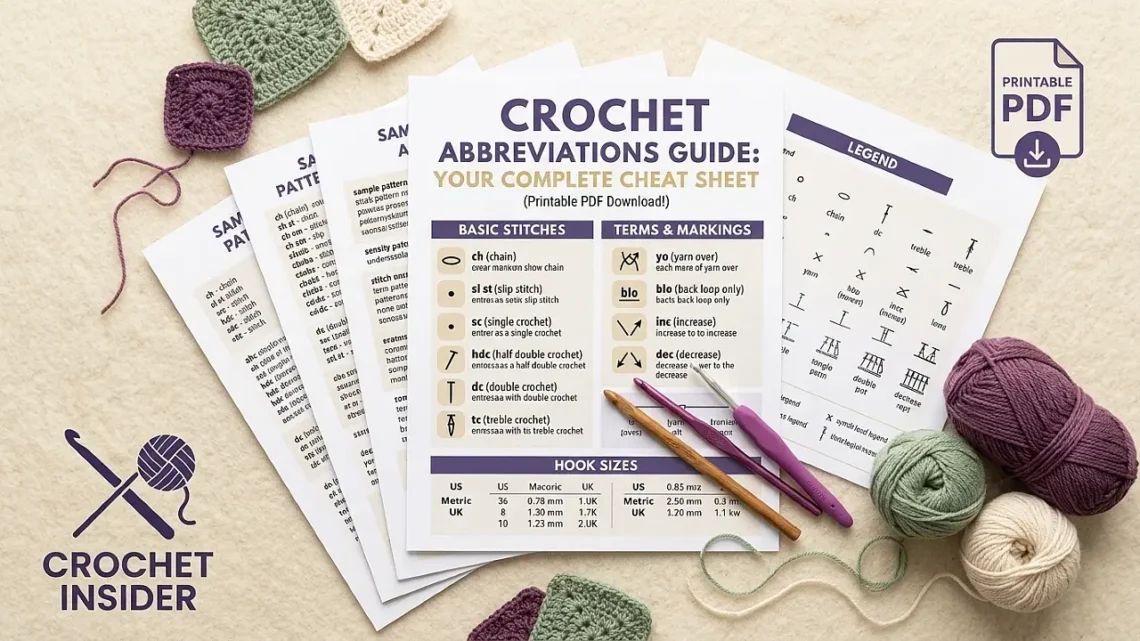
Printable guide
Here’s a compact reference table you can print and keep with your crochet supplies. Right‑click to save or copy into a document.
| Abbr | Meaning | Abbr | Meaning |
|---|---|---|---|
| ch | chain | BLO | back loop only |
| sl st | slip stitch | FLO | front loop only |
| sc | single crochet | FPdc | front post dc |
| hdc | half double crochet | BPdc | back post dc |
| dc | double crochet | inc | increase |
| tr | treble crochet | dec | decrease |
| yo | yarn over | sk | skip |
| st(s) | stitch(es) | sp | space |
| rnd | round | rep | repeat |
| MR | magic ring | FO | fasten off |
| RS | right side | WS | wrong side |
| CC | contrasting colour | MC | main colour |
| FSC | foundation sc | FDC | foundation dc |
For a high‑quality printable PDF, join the Crochet Insider community – we have a beautiful 2‑page PDF with all abbreviations, punctuation rules, and US/UK conversion.
Practice pattern using abbreviations
Here’s a simple dishcloth pattern that uses many of the abbreviations you’ve learned. Try reading it without looking at the translation.
Abbreviation Practice Dishcloth
Free patternIf you could read that without struggling, you’re ready for any beginner pattern. If not, keep this guide open while you practice.
Keep this guide forever
Bookmark this page. Pin it. Print the cheat sheet. You’ll come back to it again and again – I still look up abbreviations sometimes, especially for post stitches or unusual clusters. There’s no shame in needing a reference. The best crocheters are the ones who know how to find answers.