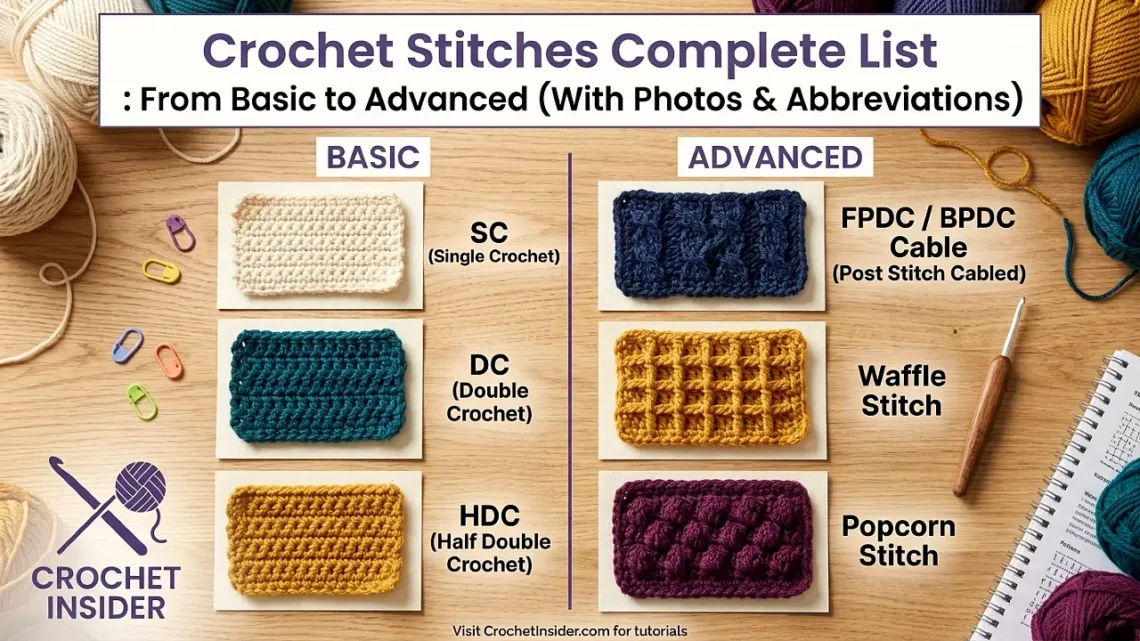
When I first started crocheting, I thought there were maybe five stitches. Then I discovered hundreds. HUNDREDS. I panicked. But here’s the truth: you only need a handful to make almost everything. The rest are variations or combinations. Think of this list as a reference library – bookmark it, print it, keep it in your project bag. I’ve organized stitches from basic (what you need to learn first) to advanced (for when you want to show off). Each entry includes the abbreviation, a brief description, and a link to a full tutorial if you need it. Let’s build your stitch vocabulary.
Basic stitches (essential for beginners)
Learn these first – they appear in almost every pattern.
Chain (ch)
Abbreviation: ch
How to: Yarn over, pull through loop on hook.
Best for: Foundation rows, turning chains, creating spaces.
Full tutorial →
Slip Stitch (sl st)
Abbreviation: sl st
How to: Insert hook, yarn over, pull through stitch and loop on hook.
Best for: Joining rounds, moving across work, seaming.
Full tutorial →
Single Crochet (sc)
Abbreviation: sc
How to: Insert hook, yarn over, pull up loop, yarn over, pull through both loops.
Best for: Dense fabric, amigurumi, dishcloths.
Full tutorial →
Half Double Crochet (hdc)
Abbreviation: hdc
How to: Yarn over, insert hook, yarn over pull up loop (3 loops), yarn over pull through all 3.
Best for: Hats, cowls, baby blankets – the Goldilocks stitch.
Full tutorial →
Double Crochet (dc)
Abbreviation: dc
How to: Yarn over, insert hook, yarn over pull up loop (3 loops), (yarn over pull through 2 loops) twice.
Best for: Blankets, scarves, granny squares – the most used stitch.
Full tutorial →
Taller stitches (treble, double treble, etc.)
Once you know double crochet, you can learn these. Each extra yarn over adds height.
Treble Crochet (tr)
Abbreviation: tr
How to: Yarn over twice, insert, yarn over pull up loop (4 loops), (yarn over pull through 2 loops) three times.
Best for: Lacy shawls, openwork blankets.
Full tutorial →
Double Treble (dtr)
Abbreviation: dtr
How to: Yarn over three times, then (yarn over pull through 2 loops) four times.
Best for: Very lacy fabric, dramatic shawls.
Triple Treble (ttr)
Abbreviation: ttr
How to: Yarn over four times, then (yarn over pull through 2 loops) five times.
Best for: Doilies, extreme lace.
Texture stitches (bobble, puff, popcorn, cluster)
These create bumpy, raised, or squishy textures. Perfect for blankets and hats.
Bobble Stitch
Abbreviation: bobble
How to: (Yarn over, insert hook, pull up loop) 5 times (11 loops), yarn over pull through all loops.
Best for: Baby blankets, textured pillows.
Puff Stitch
Abbreviation: puff
How to: Similar to bobble but with longer loops. (Yarn over, insert, pull up a long loop) 4‑5 times, yarn over pull through all.
Best for: Sunburst granny squares, winter wear.
Popcorn Stitch
Abbreviation: pop
How to: Work 5 dc in same stitch, remove hook, insert into first dc, grab the loop and pull through.
Best for: Textured blankets, flower centers.
Cluster (cl)
Abbreviation: cl
How to: Work multiple incomplete stitches (usually 3‑5 dc) into the same stitch, then join them at the top.
Best for: Granny squares, lace patterns.
Post stitches (cables, ribbing, basketweave)
Post stitches are worked around the vertical post of the stitch below, not into the top loops. They create raised ridges and cables.
Front Post Double Crochet (FPdc)
Abbreviation: FPdc
How to: Yarn over, insert hook from front to back to front around the post of the stitch below, complete double crochet.
Best for: Cables, basketweave.
Back Post Double Crochet (BPdc)
Abbreviation: BPdc
How to: Insert hook from back to front to back around the post.
Best for: Ribbing, basketweave.
Front Post Treble (FPtr)
Abbreviation: FPtr
How to: Same as FPdc but with treble crochet height.
Best for: Taller cables.
Lace and openwork stitches (V‑stitch, shell, mesh)
These create airy, lightweight fabrics – perfect for summer shawls and cover‑ups.
V‑Stitch (V‑st)
Abbreviation: V‑st
How to: (Dc, ch 1, dc) in same stitch.
Best for: Shawls, lightweight scarves.
Shell Stitch
Abbreviation: shell
How to: 5 dc (or 3 or 7) in the same stitch. Often combined with skipping stitches between shells.
Best for: Blanket borders, baby blankets, feminine garments.
Mesh Stitch (aka filet crochet)
Abbreviation: mesh
How to: (Dc, ch 1, sk 1) repeat. Creates a grid.
Best for: Market bags, light shawls, lace panels.
Combination stitches (moss, lemon peel, granny)
These aren’t single stitches – they’re repeating patterns of two or more basic stitches.
Moss Stitch (aka Linen or Granite)
Abbreviation: moss
How to: (Sc, ch 1, sk 1) across. Next row: sc in ch‑1 spaces, ch 1 over sc.
Best for: Scarves, blankets, dishcloths. Lies flat, no curling.
Lemon Peel Stitch
Abbreviation: –
How to: Alternate sc and dc across each row. Next row, sc in dc, dc in sc.
Best for: Washcloths, pillows, textured blankets.
Granny Cluster / Granny Stitch
Abbreviation: –
How to: 3 dc in same space, usually separated by chain‑1 spaces.
Best for: Granny squares, granny stripe blankets.
Ribbing (alternating BLO)
Abbreviation: BLO
How to: Work sc in back loop only of each stitch across. Creates horizontal ridges.
Best for: Hat brims, cuffs, sweater hems.
Edgings and borders (crab stitch, picot, scallop)
These are used to finish the edges of blankets, garments, and accessories.
Crab Stitch (Reverse Single Crochet)
Abbreviation: crab st
How to: Single crochet from left to right (if right‑handed) instead of right to left.
Best for: Edges that need a twisted rope look.
Picot Stitch
Abbreviation: picot
How to: Ch 3, sl st in 3rd ch from hook.
Best for: Delicate edgings, doilies, lace.
Scallop Edge
Abbreviation: –
How to: (5 dc in same stitch, sk 2 sts, sl st in next) repeat.
Best for: Blanket borders, baby items.
How to learn a new stitch
My method for learning any stitch:
- Watch a YouTube video (slow it down to 0.75x speed if needed).
- Make a practice swatch with a smooth, light‑coloured worsted yarn.
- Crochet the stitch for at least 4 rows. Don’t worry about tension – just get the motion into your hands.
- Compare your swatch to a photo online. Are you doing it correctly?
- If it’s wrong, frog (rip out) and try again. It usually takes 2‑3 attempts.
My stitch journal
I keep a notebook where I tape in a small swatch of every stitch I’ve learned, with notes on hook size and yarn. It’s become an invaluable reference. You can do the same – it’s a great way to see your progress.
Your stitch library is now open
Bookmark this page. You’ll come back to it again and again. Start with the basic stitches – master chain, sc, and dc. Then try a texture stitch like the bobble or puff. Then move on to lace and post stitches. Each new stitch you learn opens up a new category of patterns. Happy stitching.